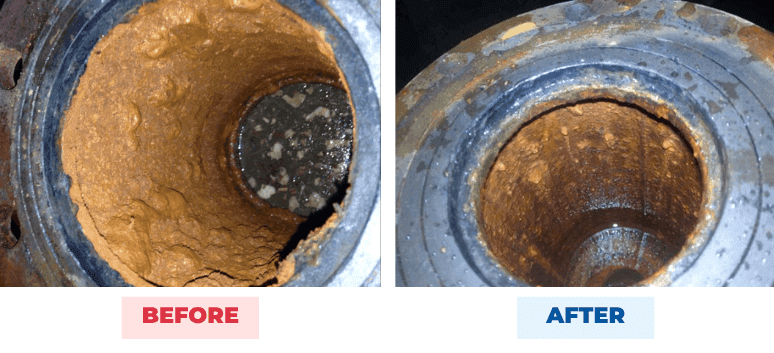
Plate heat exchanger scale was only part of the problem at an industrial plant in Ukraine. Two plate heat exchangers were fed from a single cold-water line, and an inspection before treatment found biological deposits, rust and scale on the heat exchanger connection. The plant needed to protect both exchangers and clear the existing deposits without dismantling the system for continuous mechanical cleaning. One HydroFLOW® K40 was installed on the cold-water supply, and the system was opened for inspection at four months and again at ten. By four months the biological deposits were gone and the remaining scale was visibly clearing. At ten months the inspected flange showed no scale and no biological deposits.
The Challenge
- Plate heat exchanger scale covered the internal flange surfaces
- Biological deposits were visible inside the connection
- Rust was also visible before treatment
- Two exchangers on one cold-water line both needed protecting
- Existing deposits had to be cleared without dismantling the system
The Solution
- Unit installed: one HydroFLOW® K40
- Installation point: cold-water supply pipe, upstream of both exchangers
- Monitoring period: ten months, with control openings at four and ten months
Fitting the K40 upstream of both exchangers let a single unit protect the two of them. The signal disrupts the conditions that let mineral scale and biofilm bond to metal surfaces, so the existing plate heat exchanger scale and biological deposits were progressively released into the flow rather than scraped out. Control openings at four and ten months recorded the change.