
Legionella Control
Support Your Water Safety Disrupt Biofilm & Scale Use Less Biocide, Less Often
HydroFLOW® disrupts the scale and biofilm that shelter Legionella in hot and cold water systems, ice machines and cooling towers. No chemicals, no cut into the pipe, fitted while the system runs, and your temperature regime, sampling and risk assessment stay exactly where they are.
Results from documented case studies, measured alongside each site's existing control scheme; they vary by system, water and baseline. View all Legionella case studies →
Why Legionella Keeps Coming Back: Scale and Biofilm Shelter It
Legionella grows in warm water, but it survives in biofilm, the slime layer that forms on pipe walls, shower hoses, calorifiers and cooling-tower fill, often on a base of scale. Scale also costs the plant: it insulates calorifiers and heaters, so holding 60°C at storage and 50°C at outlets takes more energy. Biofilm shields bacteria from heat and biocide, which is why results clear after disinfection and then drift back. At a 55-room Italian spa hotel, contamination returned after every sanitisation, and at a Milan hotel, Legionella kept recurring in pipework too old to take chlorine.
Typical signs a water system is sheltering Legionella:
- Positive samples that clear after a thermal or chemical disinfection, then return
- Calorifiers and water heaters struggling to hold 60°C as scale builds on the coils
- Outlets slow to reach temperature, and shower heads or TMVs crusting between descales
- Slime in ice machines, strainers, shower hoses and cooling-tower basins
- Cooling-tower bio-counts that need ever-higher biocide doses to hold
- A growing flushing log for dead legs, low-use outlets and weekend stagnation
Why Legionella Control Is a Rising Priority
Legionella can be present in almost any building water system: hot and cold services, calorifiers, showers, ice machines, spas and cooling towers. It becomes a hazard when it multiplies and is breathed in as fine droplets. Controlling it is a legal duty, not a preference. In the UK, ACOP L8 and HSG274 place it on whoever controls the premises; in the US, ASHRAE Standard 188 and the CDC's water management programme guidance set the same expectation.
3.4 cases per 100,000 in Europe
Europe's Legionnaires' disease notification rate rose to 3.4 per 100,000 in 2024, up from 3.2 the year before, with France, Germany, Italy and Spain reporting 71% of cases. US reported cases have been rising since the early 2000s.
1 in 4 fatal in healthcare settings
The CDC puts deaths at about 1 in 10 people who get Legionnaires' disease, rising to about 1 in 4 when it is caught in a healthcare facility. Hospitals, care homes and hotels carry the most exposure and the most scrutiny.
Outbreaks trace to water management
In CDC reviews of US outbreaks, every water-management failure found was preventable with a properly run programme. 43% of the buildings had no programme at all, and 40% had one that was not being followed.
Sources: ECDC, Legionnaires' disease Annual Epidemiological Report for 2024 · CDC, About Legionnaires' disease · CDC, Outbreaks and water management gaps · CDC, Legionellosis surveillance and trends · HSE, Managing legionella in hot and cold water systems. Figures are agency-reported; individual sites vary.
Where Legionella Control Breaks Down
Most Legionella problems are not a failure of the control scheme but of the surfaces it has to work on. Scale and biofilm build up in the places heat and biocide struggle to reach, and the same four patterns show up across hospitals, hotels and commercial buildings.
Hot Water Systems That Keep Testing Positive
Thermal shocks and chlorination clear the water for a while, but biofilm left in the pipework reseeds it.
Hospital Potable Water Above Target
Flushing and replacing fittings is costly, and the next step is often a new treatment plant.
Cooling Towers Held Only by Biocide
Warm, aerated tower water grows biofilm on fill and basins, so doses climb just to hold the count.
Ice Machines & Outlets Harbouring Biofilm
Ice machines, shower hoses and low-use outlets hide biofilm that routine cleaning does not reach.
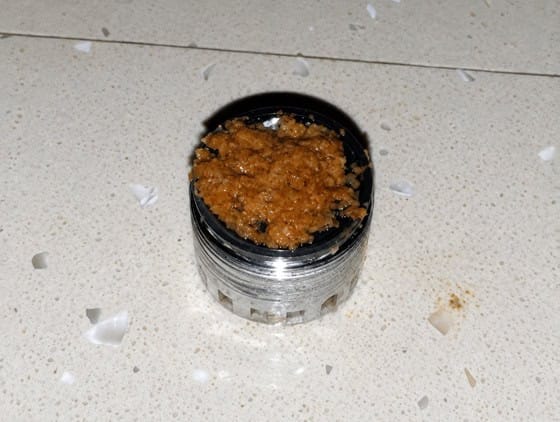
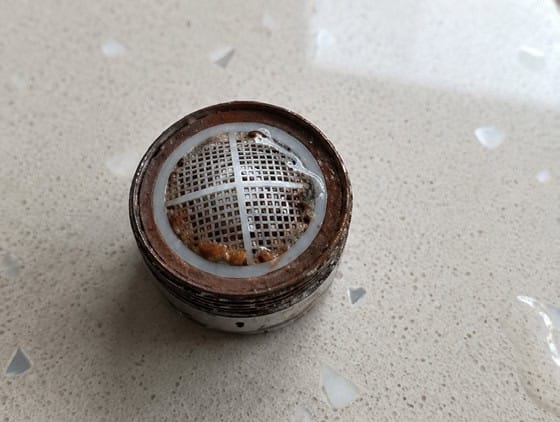
Grand Hotel Terme di Comano, Italy: biofilm had blocked the tap jet breakers, and Legionella returned after every sanitisation. With HydroFLOW® units on the incoming main and both hot-water manifolds, alongside thermal shock and purging, certified testing found every sample below 10 CFU/L, still within limits seven months after the last thermal shock. Read the case study →
Where the Savings Add Up
Legionella control is paid for in repeat disinfections, biocide, water, cleaning hours, energy and treatment plant. These are the six lines where sites have measured a difference.
Fewer Repeat Disinfections
Every thermal shock or chlorination costs plant time, contractor days and flushing. When biofilm is not reseeding the system, results hold longer: Hotel Des Etrangers in Milan, whose ageing pipework could not take chlorine, has reported no Legionella recurrence since December 2017.
Less Biocide & Chlorine to Buy
Cleaner surfaces need less chemistry to hold the same count. A California hospital cut cooling-tower biocide by 75%, and a US apple packer held non-detect results at 10 ppm chlorine instead of 40–50 ppm, up to 80% less.
Water Saved at the Cooling Tower
When scale stops forming, towers run at higher conductivity with less blowdown. The California hospital cut blowdown by over 65%, and Sunrise Children's Hospital in Las Vegas stopped chemical dosing while holding its biological count below 1,000 CFU/ml.
Less Cleaning of Ice Machines & Outlets
Biofilm that does not bond is easier to clean away. A US hospital extended cleaning beyond its 3–4 month cycle across 112 ice machines, and a Kentucky hospital's ICU ice maker cleared over 90 days, with payback projected under a year.
Energy Held at Temperature
Scale insulates the surfaces that keep hot water at 60°C, and around 1 mm can cut heat transfer by about 7%. At MGEN Trois-Épis, a French rehabilitation hospital, the hot-water exchangers have run five years with no limescale maintenance, at €50 per 1,000 m³ against €1,250 for the softeners they replaced, and no Legionella alert has been detected since.
Treatment Plant You Don't Have to Buy
A single fitting with no consumables. The Indiana hospital no longer needed a proposed $75,000 treatment system, the M/V Harvest Leader removed its UV steriliser with 0 CFU in follow-up tests, and a US office complex put its estimated ROI at about six months.
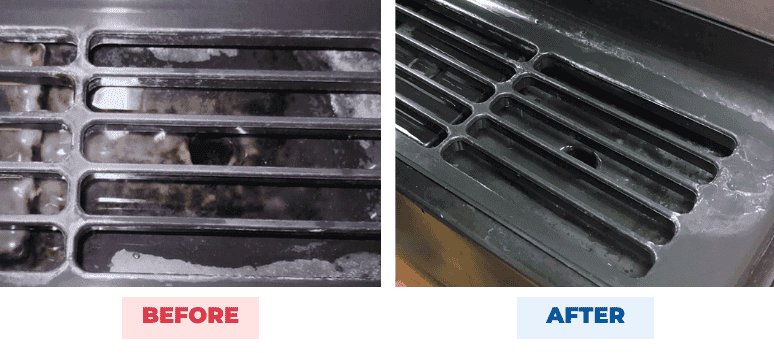
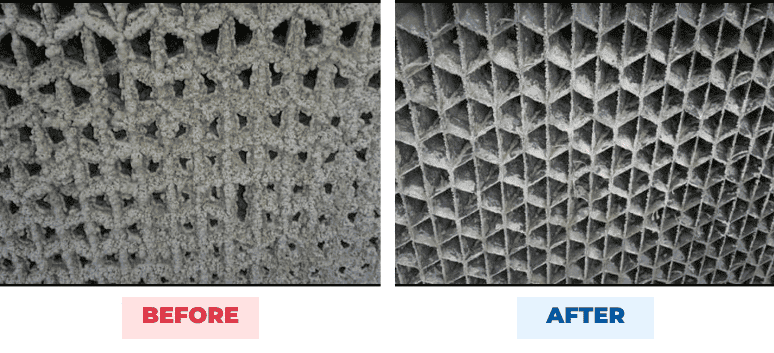
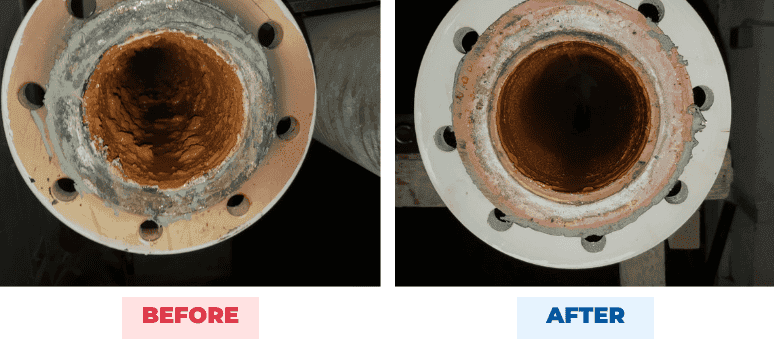
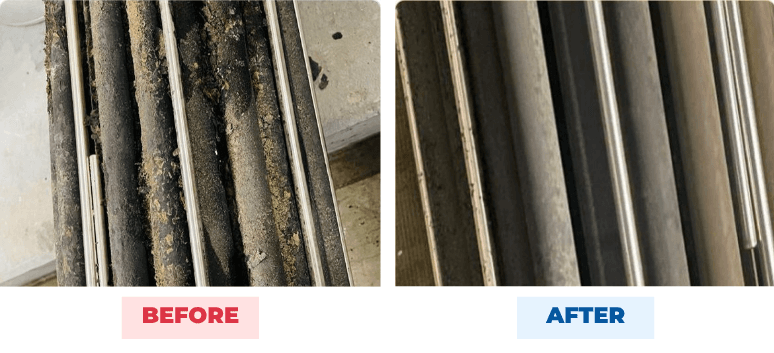
Central Kentucky hospital: scale and biofilm had built up in the ice maker serving the intensive care unit. Over a 90-day evaluation with one HydroFLOW® HS38 on the cold-water supply, existing deposits were progressively removed from the tray, the chute and the ice-making surface.
ICU ice maker tray before and after HydroFLOW, scale and biofilm deposits progressively removed over 90 days, Central Kentucky hospitalDon’t take our word for it. Test it on your own system.
Every result on this page came from a site's own records. Start the same way: one unit on one system, with your control scheme unchanged, measured against your own sampling results, temperature logs and chemical use.
Get a Free Site Water Assessment
Legionella Water Treatment Physical, Not Chemical!
A physical treatment for the scale and biofilm that shelter Legionella in hot and cold water systems, ice machines and cooling towers, powered by a patented electronic signal
HydroFLOW® induces a patented ~150 kHz signal into the water through the pipe wall. The signal changes how dissolved minerals behave, so calcium and magnesium crystallise in suspension instead of bonding to calorifier coils, pipe walls and tower fill as hard scale. It also disrupts the conditions biofilm needs to bond to surfaces, so existing biofilm loosens and is carried away rather than thickening on the walls.
That matters because Legionella control rests on temperature, flow and clean surfaces. Clean heat-transfer surfaces make it easier to hold 60°C at storage, and clean pipe walls leave bacteria less shelter from the heat or biocide already in the system. The signal propagates in both directions through the pipework from a single point, on copper, steel and plastic alike, and keeps working on water standing in low-use outlets, dead legs and weekend shutdowns: the stagnant periods when biofilm consolidates.
So does it replace your disinfection? No. HydroFLOW® is not a disinfectant and does not kill Legionella. Your risk assessment, temperature regime, flushing, biocide and sampling programme stay exactly as they are. Nothing enters the water, so its composition and taste are unchanged and there is nothing new for your water safety plan to declare. We can supply the technical documentation your risk assessor or water treatment contractor asks for.
Learn More About Our TechnologyOne Technology — Cleaner Surfaces, Fewer Places to Hide Legionella
How scale and biofilm leave a treated system, what to expect in the first weeks, and what a long-term record looks like.
Deposits Leave the System
With new scale no longer forming and biofilm unable to bond firmly, existing deposits loosen from pipe walls, coils and machine surfaces and are carried out with the water. At a US hospital, biofilm that previous cleaning had missed was released within 3 weeks.
Gradual, With a Clearing Phase
Removal is progressive: no acid, no drain-down, no metal thinned by a descale. Expect loosened material at strainers, filters and shower heads in the first weeks, and plan extra sampling. At Comano, counts rose briefly as old biofilm released, before every sample fell below 10 CFU/L; in Milan, detached deposits showed up at the taps.
Measured Over Five Years
At MGEN Trois-Épis, twelve units replaced six salt softeners on a hospital hot-water system fed by water at about 330 ppm. Five years on, there has been no limescale maintenance and no scale-related pipe blockage, and where a few Legionella alerts used to occur each year, none has been detected since installation.
How the Legionella Control Methods Compare
HydroFLOW® is not an alternative to disinfection. This is how it sits alongside the methods your risk assessment may already specify.
| HydroFLOW®Physical treatment, works alongside | Temperature control & thermal disinfection | Chlorine dioxide dosing | Copper-silver ionisation | Point-of-use filters | |
|---|---|---|---|---|---|
| How it works | Electronic signal keeps minerals crystallising in suspension and disrupts the conditions biofilm needs to bond | Store hot water at 60°C or above, distribute at 50°C or above, keep cold below 20°C; periodic heat-and-flush disinfection | An oxidising biocide dosed continuously into the supply | A flow cell releases copper and silver ions into the water | A membrane filter fitted at each tap or shower |
| Acts on Legionella directly | Indirect Not a disinfectant. Reduces the scale and biofilm that shelter bacteria | Yes Heat stops growth; disinfection raises temperature further | Yes Biocidal residual through the system | Yes Metal ions act on bacteria in the water | At the outlet Retains bacteria at that fitting only |
| Effect on biofilm | Disrupts Existing biofilm loosens and leaves; new biofilm struggles to bond | Partial Biofilm can shelter bacteria from heat, so results may drift back | Good Penetrates biofilm, but must be kept at the right residual | Partial Depends on keeping ion levels in range | None No effect on biofilm in the pipework upstream |
| Effect on scale | Reduces Stops new scale bonding and gradually removes existing deposits | Worse Higher temperatures speed up scaling in hard-water areas | None Not a scale treatment | None Scale on electrodes needs cleaning | Worse Filters block faster in hard water |
| What goes into the water | Nothing Composition and taste unchanged | Heat Scald risk managed with TMVs | Chemical Residual and by-products to monitor | Metal ions Copper and silver levels to monitor | Nothing |
| Running costs | None No consumables, no dosing, no servicing schedule | Energy Heating to hold temperature, plus logging and flushing labour | Ongoing Chemical supply, dosing equipment and residual testing | Ongoing Electrode replacement and ion testing | High Filter replacement at every protected outlet |
| Fits an L8 / water management scheme | Alongside Supports the scheme; risk assessment, temperatures and sampling stay | Core The primary control in most UK schemes | Yes A recognised control option | Yes A recognised control option | Targeted Usually for high-risk outlets or as an interim measure |
| Downtime to fit | None Installs around the existing pipe; no cut-in, no drain-down | Varies Needs plant that can reach temperature; disinfection means flushing every outlet | Cut-in Injection point, dosing pump and chemical storage | Cut-in Flow cell on the pipework plus a controller | Per outlet Fitted outlet by outlet |
Swipe sideways to compare all five methods →
Comparison reflects typical products in each category; individual systems vary. HydroFLOW® is not a filter and not a disinfectant. It does not replace temperature control, biocide or ionisation where your risk assessment specifies them, it does not replace sampling, and ACOP L8 / HSG274 duties remain in place.
Applications
Legionella control applications
Legionella risk follows water wherever it is stored warm, left standing or sprayed as droplets. Each sector links to its dedicated page.
Hospitals & Care Settings
Supports water safety plans in potable systems, calorifiers and ice machines, fitted to live systems with no ward closures.
Hotels & Spas
Keeps calorifiers, showers and spa circuits clear of the scale and biofilm that let Legionella return after each sanitisation.
Commercial Buildings & HVAC
Protects hot-water plant, washrooms and chillers across offices, retail and residential blocks, with low-occupancy periods covered.
Cooling Towers
Reduces scale and biofilm on fill, basins and condensers so biocide programmes hold bio-counts with lower doses.
Data Centres
Supports Legionella risk management in evaporative and hybrid cooling without adding chemicals to the cooling loop.
Ships & Marine Potable Water
Protects onboard drinking-water systems and calorifiers from scale and biofilm, where a vessel cannot shut its supply.
Related problems have pages of their own: biofouling & biofilm, limescale, ice makers and pools & spas. For the science, see how HydroFLOW® works.
Process Overview
Simple Installation. Supply Stays Live.
Our patented technology retrofits onto your existing pipework without changing your control scheme.
The Fit
The HydroFLOW® unit installs around your existing pipework, on the incoming main, a calorifier feed or a tower recirculation line, with no cutting and no drain-down. The supply stays live, and your temperature regime, flushing and sampling carry on unchanged.
The Signal
A patented electronic signal propagates in both directions through the water, treating the circuit from a single point. It works through copper, steel and plastic, and keeps working on water standing in low-use outlets, dead legs and weekend shutdowns.
The Results
Counts can move within days, as they did at a US office complex's cooling tower. Expect a clearing phase over the first weeks, like the 3-week biofilm release in one hospital's ice machines. The proof builds over years: a Milan hotel has reported no Legionella recurrence since 2017.
Proven On Site
Real Systems. Real Results.
Drawn from certified testing, site sampling records and our customers' own logs across hospitals, hotels and commercial cooling.
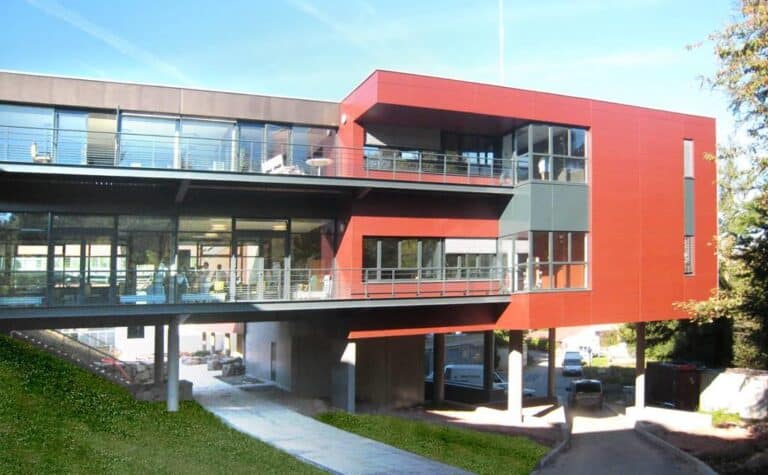
MGEN Trois-Épis: Hospital Hot Water Scale Free for 5 Years
The 206-bed MGEN Trois-Épis rehabilitation centre replaced six salt softeners with 12 HydroFLOW® units and has had five years with no limescale maintenance.
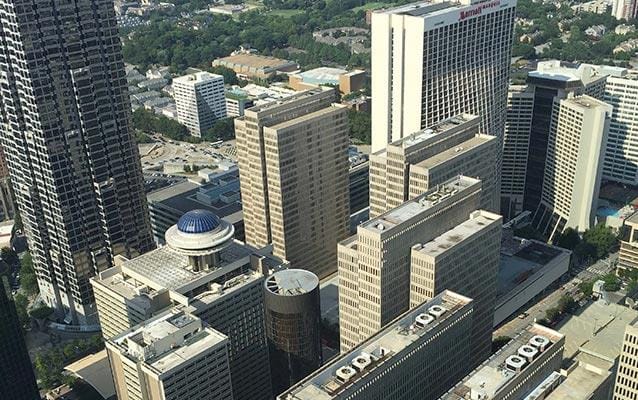
US Office Complex: Bio-Counts 100,000 to Under 1,000
A 2.3 million sq ft US office complex cut cooling tower bio-counts from 100,000 CFU to below 1,000 within days with one HydroFLOW® Custom 14 inch unit.
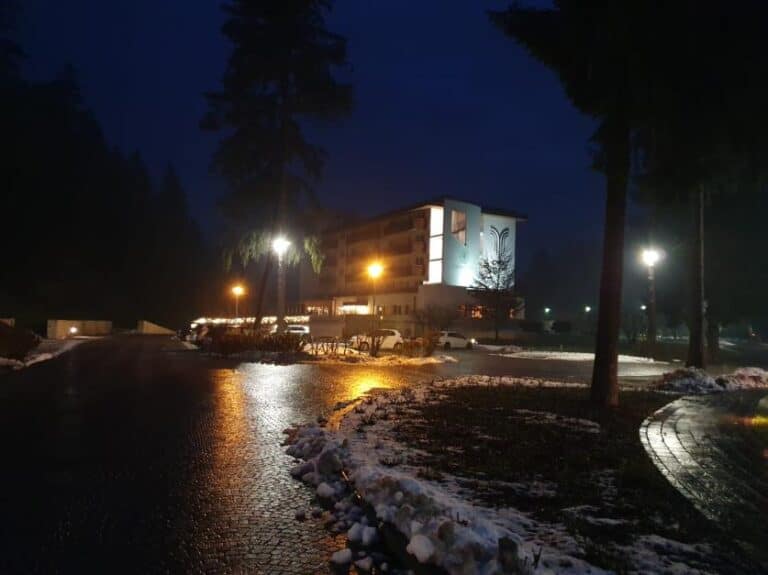
Comano: Legionella Under 10 CFU/L for Seven Months
Grand Hotel Terme di Comano brought every certified Legionella sample below 10 CFU/L and stayed within limits for seven months with three HydroFLOW® units.
Support & FAQ
Frequently Asked Questions
What is Legionella and where does it grow?
Legionella is a waterborne bacterium that causes Legionnaires' disease when people breathe in contaminated droplets from showers, taps, cooling towers or spas. It is not usually spread from person to person. It multiplies in water between about 20°C and 45°C, and it survives in biofilm: the slime layer that forms inside pipework, calorifiers, shower hoses, ice machines and cooling-tower fill, often on a base of scale. That is why control focuses on three things: temperature, flow and clean surfaces.
What kills Legionella in water?
Heat and biocides. Water held above 60°C stops Legionella multiplying, and thermal disinfection raises the temperature further for a set time. Chlorine, chlorine dioxide, and copper-silver ionisation are the common chemical and ion-based controls, and HSE lists ionisation and chlorine dioxide as options. HydroFLOW® is not one of them: it does not kill Legionella. What it does is reduce the scale and biofilm that shelter bacteria from those controls, so the heat or biocide already in your system can reach them.
What temperature stops Legionella growing?
HSE guidance for hot and cold water systems is to store hot water at 60°C or higher, distribute it at 50°C or higher, and keep cold water below 20°C, because Legionella multiplies in the range between. Scale makes those figures harder to hold: around 1 mm on a calorifier coil can cut heat transfer by about 7%, so the plant works harder to reach temperature and stored water has less margin. Keeping heat-transfer surfaces clean is one of the simplest ways to protect the temperature regime. At MGEN Trois-Épis, a French hospital, the plate exchanger was still free of limescale after five years of treatment.
Why does biofilm make Legionella harder to control?
Biofilm is a layer of microbes and the slime they produce, bonded to pipe walls and other wet surfaces. Legionella lives inside it and inside the amoebae that graze on it, where it is shielded from heat and biocide. That is why a system can test clear after disinfection and then test positive again weeks later: the biofilm reseeds the water. HydroFLOW® disrupts the conditions biofilm needs to bond to surfaces, so existing biofilm loosens and is carried away. At a US hospital, biofilm that routine cleaning had missed was released from its ice machines within three weeks.
How does scale increase Legionella risk?
In two ways. Rough scale gives biofilm a large, sheltered surface to anchor to, in calorifiers, shower heads, TMVs and tower fill. And scale insulates heat-transfer surfaces, so hot water is harder to hold at temperature. HSE asks for shower heads and hoses to be cleaned and descaled at least quarterly for this reason. Treating scale at source reduces both effects: at the Palace of Parliament in Bucharest, visual inspection found about 50% less biofouling in hot-water pipework after six months.
How do you control Legionella in cooling towers?
Cooling towers are warm, aerated and full of surface area, so they need a biocide programme, monitoring and regular cleaning under the site's risk assessment. Those stay. HydroFLOW® reduces the scale and biofilm on fill, basins and condensers that biocide has to fight through. At a California hospital, biocide use fell by 75% with counts below 1,000 CFU, and blowdown fell by over 65%. At a large US office complex, bio-counts fell from approximately 100,000 CFU to below 1,000 within days. These are total bio-counts, measured alongside each site's own programme.
What is an acceptable level of Legionella in water?
There is no single figure for every system. Action levels are set by national guidance and by your own risk assessment, and they differ between hot and cold water, cooling towers and healthcare settings. Any positive result should be reviewed with whoever manages your scheme. For reference, the sites on this page worked to their own targets: an Indiana hospital aimed for below 1 CFU/mL and reached it within 16 days, Grand Hotel Terme di Comano recorded every sample below 10 CFU/L, and a US office complex's cooling tower targeted a total bio-count below 10,000 CFU.
Is Legionella control a legal requirement?
Yes, in most markets. In the UK, the Health and Safety at Work Act and COSHH apply, and the HSE's ACOP L8 and HSG274 set out how: a risk assessment, a written control scheme, a responsible person, and records. In the US, ASHRAE Standard 188 and the CDC's water management programme guidance set the expectation, and many states and cities regulate cooling towers directly. HydroFLOW® fits inside that scheme as a supporting measure. It does not replace any part of it, and it does not reduce your duty to test.
Does electronic water conditioning kill Legionella?
No, and we would be wary of anyone who claims it does. HydroFLOW® is not a disinfectant, and scepticism about electronic water treatment is often earned: the market has plenty of low-cost wrap-around devices with little evidence behind them. What we can show is narrower. The unit induces a patented ~150 kHz signal into the water, sized to the pipe and the application, and it reduces the scale and biofilm that shelter bacteria. Sites that kept their control scheme in place recorded the results on this page, including an Indiana hospital where Legionella fell from an average of 7 CFU/mL to below 1 CFU/mL. At a US apple packer, counts rose again when the signal was switched off. Judge it on a trial against your own sampling.
Can HydroFLOW replace chlorine dioxide, ionisation or thermal disinfection?
No. If your risk assessment specifies a biocide, ionisation or a thermal regime, it stays. What sites have found is that they needed less of it: a California hospital cut cooling-tower biocide by 75%, and a US apple packer held non-detect results at 10 ppm chlorine instead of 40 to 50 ppm. At Comano, HydroFLOW® was installed as part of a programme that also included thermal shock and purging. One site on this page does run without chemicals, and it had a reason: at Hotel Des Etrangers in Milan, the ageing pipework could not take chlorine, so the hotel chose HydroFLOW® with no chemical dosing in December 2017, and no Legionella recurrence has been reported since. That was the site's decision for its own system. Any change to your scheme is a decision for your responsible person, based on your own results.
Can it be fitted without shutting down the water system?
Yes. The unit installs around the outside of the existing pipe, with no cutting, no drain-down and no interruption to supply. At MGEN Trois-Épis, twelve units went in on one day without interrupting the hospital's water service. Plan for the clearing phase: as scale and biofilm release, expect more material at strainers, filters and shower heads in the first weeks, and possibly a short rise in counts. Comano recorded exactly that before every sample fell below 10 CFU/L, and in Milan the detached deposits appeared at the taps, so schedule extra sampling and outlet flushing after installation. That also makes a trial straightforward: one unit on one system, measured against your own results.
Ready to Take Scale and Biofilm Out of Your Legionella Risk?
Tell us about your site, its water systems and where positive samples or slime keep appearing. Our team will recommend the right units and set out what to expect, including where our assessment is that we cannot help. This is not a Legionella risk assessment, and it sits alongside yours.
Ready to explore sustainable water treatment?
Get in touch to find out how HydroFLOW® can work for you.

© 2026 Hydropath Technology Ltd. All rights reserved