
Heat Exchanger Scale and Fouling Control
Keep Plates and Tubes Clean Longer Between Cleans Less Acid, Less Downtime
HydroFLOW® treats the water feeding your heat exchangers electronically: no chemicals, no salt, no cut into the pipe, fitted while the plant runs. Plates and tubes stay cleaner for longer, so you open, acid-clean and re-gasket less often.
Results from documented case studies; they vary with water chemistry, temperature, flow and system design. View all heat exchanger case studies →
Fouling Costs a Heat Exchanger Twice: in Lost Heat and in Cleaning
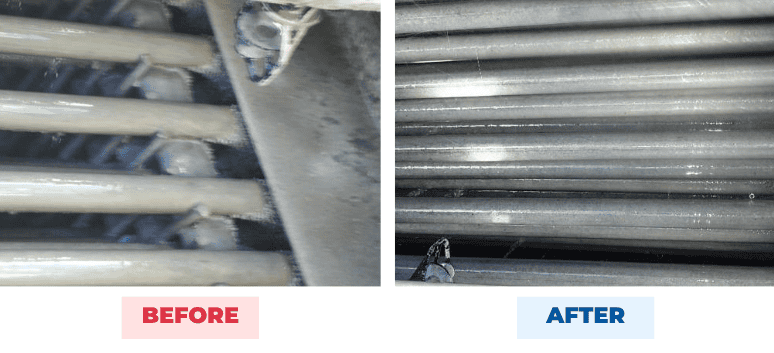
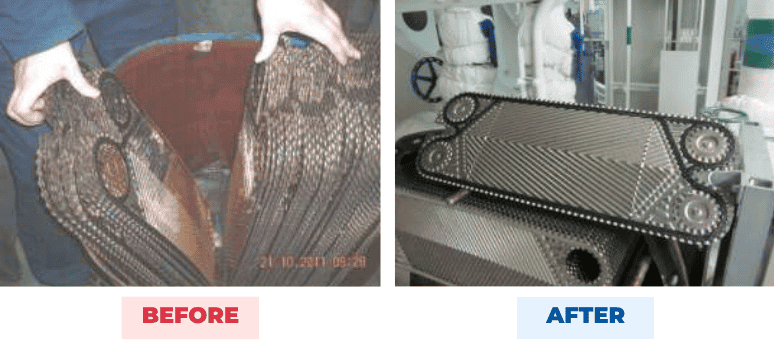
Every heat exchanger is built to move heat across a thin wall, and every deposit on that wall works against it. Mineral scale, biofilm and marine growth insulate plates and tubes and narrow the channels, so pumps work harder and outlet temperatures drift. The cleaning that follows costs twice again: at a Middle East hospital, the exchangers came offline for acid cleaning every three to four months, and the cleaning agents wore the seals and gaskets. On the car carrier MV Hoegh America, up to 3 mm of scale built up on titanium plates, and each clean took 24 to 48 hours.
Typical signs a heat exchanger is scaling or fouling:
- Differential pressure climbing across the plate pack or tube bundle
- Outlet temperature or approach drifting away from design
- Flow falling, or pumps running harder for the same duty
- Acid cleans or CIP cycles coming round more often
- Gaskets and seals needing replacement after repeated cleaning
- Slime, shells or grit at the strainers and inlet ports
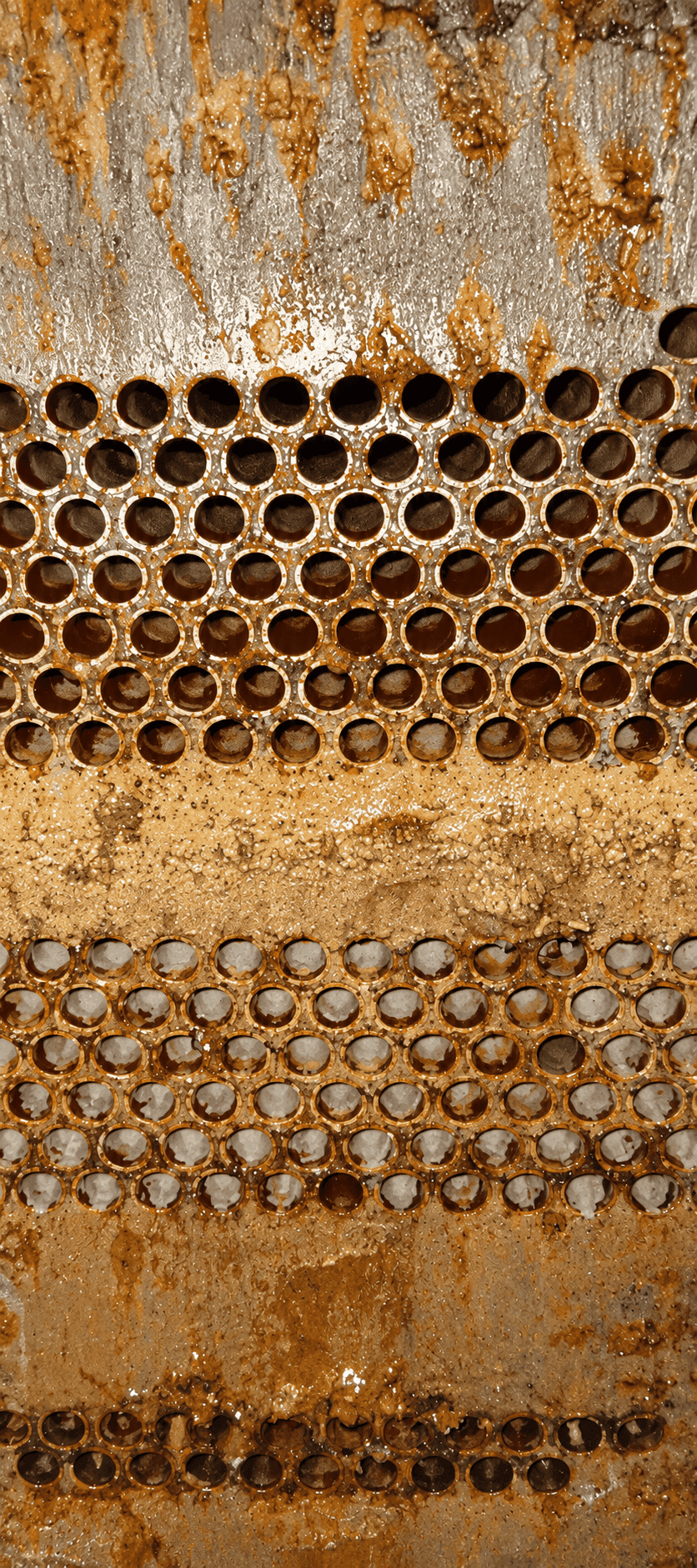
What Does Fouling Cost a Heat Exchanger?
Fouling is the build-up of unwanted deposits on heat transfer surfaces: mineral scale, biofilm, sediment and corrosion products. Even a thin layer insulates the plates or tubes, so the exchanger loses heat transfer, needs more pumping and energy, and has to be opened and cleaned more often. Plate, shell-and-tube and condenser designs all suffer it, and the cost lands in several budget lines at once: energy, cleaning contractors, chemicals, gaskets and lost output.
About 0.25% of GDP
Heat exchanger fouling has been estimated to cost industrialised countries around 0.25% of their gross domestic product. The figure comes from national studies now decades old, but it remains the reference estimate in the fouling literature.
0.6 mm can cost a chiller 20%
Australian Government HVAC guidance is widely quoted as saying that a 0.6 mm layer of fouling on condenser water tubes will reduce chiller efficiency by 20%. Condenser tubes and plate channels sit exactly where hard or biologically active water meets the heat load.
Up to 2.5% of global CO₂
Estimates of the carbon cost of heat exchanger fouling range from 1% to 2.5% of the world's CO₂ emissions, mostly from the extra fuel burned to make up lost heat recovery in process industry. Wherever fouling forces more fuel or power through the same duty, it adds emissions.
Sources: Müller-Steinhagen, Malayeri & Watkinson, Heat Exchanger Fouling: Mitigation and Cleaning Strategies, Heat Transfer Engineering (2011) · Australian Government, Guide to Best Practice Maintenance & Operation of HVAC Systems for Energy Efficiency (2012) · Ben-Mansour et al., Fouling in Multiphase Flow Heat Exchangers: A Review, Energies (2023). Figures are published estimates; individual sites vary.
Where Fouling Hits Each Type of Heat Exchanger
Plate packs block at the channels, tube bundles lose heat transfer on the waterside, and every type pays for the acid cleans that follow. Each problem below is paired with a site that measured the fix.
Shell-and-Tube & Condenser Tubes Losing Heat Transfer
Scale and biofilm line the waterside of the tubes, and the approach drifts until the bundle is opened and cleaned.
Plate Heat Exchangers Blocking at the Channels
In addition to losing heat transfer, narrow plate channels trap shells, silt and biofilm, so differential pressure climbs and flow falls.
Acid Cleaning Every Few Months
Each acid clean takes the exchanger offline, brings chemicals into the plant room and wears the gaskets.
Seawater & Fresh Water Generator Plates at Sea
Scale and slime on FWG plates cut water output and bring chemical CIP round every week or two.
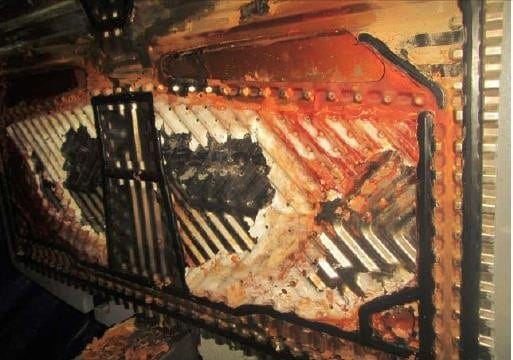
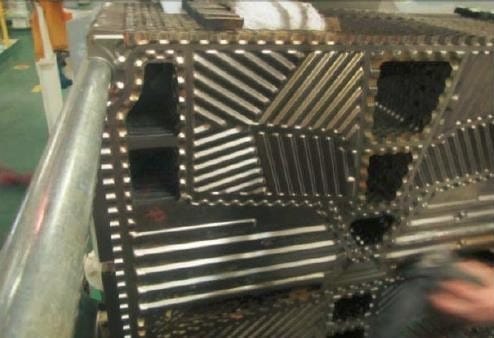
MV Detroit Express: scale, bacteria, algae and slime meant chemical cleaning of the fresh water generator every 10 to 12 days. After one HydroFLOW® unit was fitted to the seawater inlet, chemical cleans fell from about 36 to 5 in 12 months and FWG openings from 12 to 5, with no dosing or cleaning chemicals. Read the case study →
Where the Savings Add Up
Corrosion costs you in openings, chemicals, heat transfer, water and replacement pipe. Six of those costs, each with a measured site behind it.
Fewer Openings & Cleans
When deposits stop bonding, exchangers stay in service longer. Enaex in Chile opened its heat exchangers 80% less often, UBC Baton Rouge's fresh water generator ran 3× longer between openings, and Taj Chandigarh stopped weekly condenser cleaning on 1,000 ppm water.
Heat Transfer Recovered
Around 1 mm of scale can cut heat transfer by about 7%. A Hong Kong chiller plant recorded a 16% efficiency gain over a year, and at a Chinese power plant, condenser vacuum rose by 1 kPa with no hard scale at the three-month inspection.
Less Acid & Dosing
Surfaces that stay cleaner need less chemistry to keep them that way. A fresh water generator trial in Japan stopped chemical dosing with output held at 15 t/day, and Tims Dairy in the UK halved both its milk-line cleans and the phosphoric acid each one used.
Shorter, Easier Cleans
When cleaning is still needed, deposits come away by hand. A car carrier's FWG clean fell to 2–3 hours without chemical soaking, and M/V Hermes Leader opened its FWG after 4,000 hours to find most of the scale detaching easily.
Longer Plate & Gasket Life
Every acid clean and every scrape costs plate, tube and gasket life. MGEN Trois-Épis in France found its plate exchanger free of limescale after five years, and at a Kyiv brewery, deposits that once needed a chisel came off by hand after a month.
Fast Return on Investment
One fitting, no consumables. Imperial Oil recorded a 7.2-month return after cutting antiscalant to zero, and a Chinese LNG plant estimates $56,000 a year saved on condensers it used to clean every four to six months.
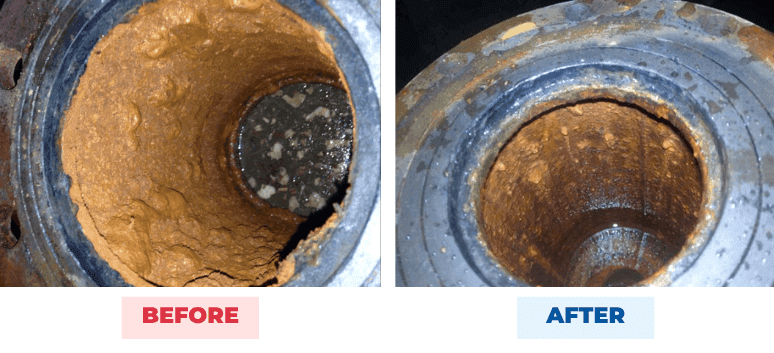
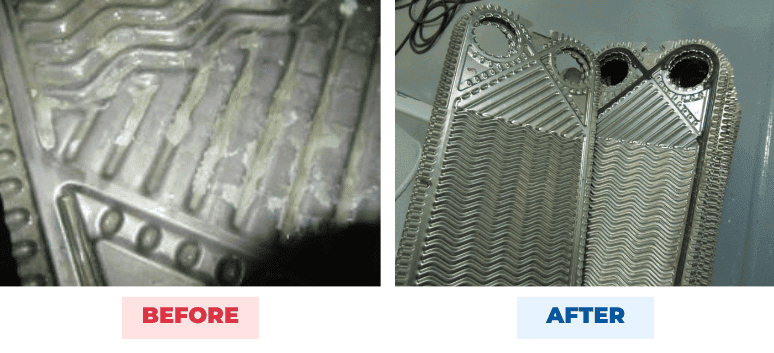
Industrial plant, Ukraine: one HydroFLOW® K40 on the cold-water supply, upstream of two plate heat exchangers. Biological deposits were gone by the four-month inspection, and the inspected flange showed no scale at ten months. Existing scale was released gradually into the flow rather than scraped out.
Plate heat exchanger flange before and after, UkraineDon’t take our word for it. Test it on your own heat exchanger.
Fit one unit upstream of one exchanger and measure it against the records you already keep: differential pressure, approach temperature, cleaning dates and chemical use. We provide a documented step-by-step testing protocol.
Get a Free Site Water Assessment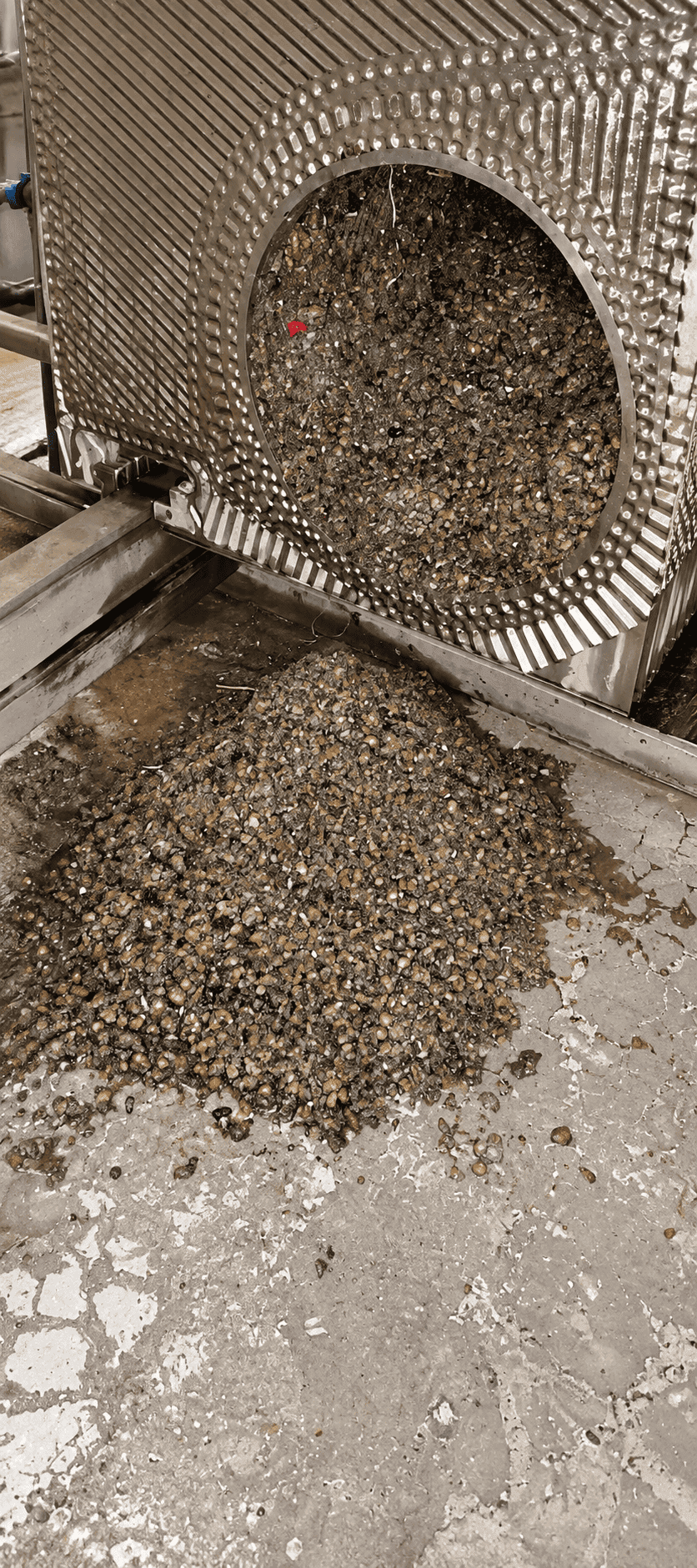
Heat Exchanger Water Treatment Physical, Not Chemical!
A physical treatment for plate, shell-and-tube and condenser heat exchangers, powered by a patented electronic signal
HydroFLOW® induces a patented ~150 kHz signal into the water through the pipe wall. The signal changes how dissolved minerals behave: instead of bonding to plates and tube walls as hard calcium carbonate scale, they form loose clusters that crystallise in suspension where the water heats up, and travel through the exchanger as fine particles. The same signal disrupts the conditions biofilm needs to bond to a surface, which is why the case studies record less slime as well as less scale.
The unit installs around the supply pipe upstream of the exchanger, with no cut into the pipe and no shutdown, and the signal travels in both directions through the water. One unit can cover more than one exchanger: at a Ukrainian industrial plant, a single K40 protects two plate heat exchangers on one cold-water line, and at Enaex in Chile, one unit sits 126 m upstream, before the seawater main splits to every exchanger.
Nothing is fitted inside the exchanger and nothing is added to the water, so plates, gaskets and tubes see no new chemistry. It treats the water side only. It does not reach the product side or the air side, and it does not replace the cleaning procedure your exchanger's manufacturer specifies. The aim is to need that procedure less often, and we can supply the technical documentation your engineer or water treatment contractor asks for.
Learn More About Our TechnologyOne Technology — Across Every Exchanger Type
Plate, shell-and-tube, condensers and fresh water generators: one fitting on the supply pipe changes what reaches the heat transfer surface.
Existing Deposits Loosen
Once less new scale is forming, the water can take old deposits back into solution, layer by layer, and softened biofilm washes away with the flow. At a Ukrainian plant, existing scale was released progressively, and the inspected flange showed no scale after ten months.
Gradual, So Plan for Debris
Removal is slow by design: no acid on the plates, no gaskets attacked, no exchanger out of service. But loosened scale and biofilm have to go somewhere. Plate channels are narrow, so check strainers in the first weeks and inspect the pack at the next opportunity after install.
Measured Over Five Years
At MGEN Trois-Épis hospital in France, twelve units replaced six salt softeners on very hard water, fitted in one day without interrupting supply. Five years on, the plate exchanger is free of limescale and there has been no limescale maintenance at all.
A Different Approach to Heat Exchanger Fouling
How HydroFLOW® compares with the ways plants usually keep heat exchangers clean.
| HydroFLOW®Physical treatment, no chemicals | Acid cleaning & CIP | Antiscalant & biocide dosing | Softening or RO pre-treatment | Automatic tube cleaning | |
|---|---|---|---|---|---|
| How it works | Electronic signal makes minerals crystallise in suspension and disrupts biofilm bonding, so less sticks to plates and tubes | Strips deposits after they have formed, with the exchanger offline | Chemistry dosed into the circuit slows crystal growth and controls bacteria | Removes hardness (and with RO most dissolved solids) before the water reaches the exchanger | Balls or brushes pass through condenser tubes to wipe the waterside |
| Plate and shell-and-tube | Both Documented on plate packs, tube bundles, condensers and marine FWGs | Both The standard reset for either | Both Circuit-wide | Both Upstream of any design | Tubes only Not applicable to plate exchangers |
| Biofilm & marine growth | Reduced Treated PHE stayed largely open while its untreated twin blocked to 3 ft | Removed At each clean, then regrows | Controlled Biocide dose limited by discharge rules | No Softening does not address biology | Partly Wipes soft film from tubes; nothing upstream |
| Exchanger offline? | No Works while the exchanger runs | Yes Every clean | No Runs continuously | No Runs continuously | No Runs in service |
| What touches plates, tubes & gaskets | Nothing new Nothing added to the water | Acid Metal loss and gasket wear over repeated cleans | Chemistry Compatibility and dose control to manage | Changed water Soft or demineralised water needs its own corrosion control | Mechanical Balls or brushes in constant contact with tube walls |
| Existing deposits | Loosens Gradually, over months | Removes Quickly, at the cost of downtime | Partial Depends on programme | No Prevention only | Soft only Keeps soft deposits down; hard scale stays |
| Consumables | None No salt, acid or dosing | Acid, neutraliser and labour at every clean | Continuous chemical purchase, storage, handling and monitoring | Salt and regeneration water, or membranes and reject water | Replacement balls or brushes and system maintenance |
| Downtime to fit | None Installs around the existing pipe, no cut, no drain-down | Not applicable | Injection point, pump, tank and controls | Cut-in plant, drainage and power | Fitted into the condenser water boxes and pipework |
Swipe sideways to compare all five methods →
Comparison reflects typical products in each category; individual systems vary. HydroFLOW® is not a descaler, a softener, a filter or a biocide. Your cleaning procedure, monitoring, closed-loop corrosion inhibitor where specified, and any food-safety CIP stay in place.
Applications
Heat exchangers, sector by sector
Every sector runs heat exchangers, and each has its own water. Each card links to the sector page and its case studies.
Marine: Fresh Water Generators & Coolers
Plate FWGs and seawater coolers on car carriers and cargo ships, with output held and cleaning cut from days to hours.
Power Plants: Steam Condensers
Large surface condensers on river and cooling-tower water, where every kilopascal of vacuum shows up in output.
Commercial HVAC: Chillers & Plate Exchangers
Chiller condensers and plate exchangers in malls, offices and seawater-cooled buildings, from single chillers to 100-unit estates.
Food, Dairy & Beverage
Plate-pack coolers and brewery tube bundles, where fewer cleans mean more production time. Your food-safety CIP stays in charge.
Hospitals: Hot Water Exchangers
Domestic hot water plate exchangers on hard water, treated without shutting supply to wards.
Manufacturing, Mining & Oil
Process coolers and shell-and-tube exchangers on well, river or recycled water, from injection moulding to oil and gas.
Related pages: cooling towers, data centres, seawater cooling systems, limescale, biofouling and corrosion (MIC). For the units themselves, see industrial products.
Process Overview
Simple Installation. No Exchanger Out of Service.
Our patented technology installs around the pipework feeding your exchanger while the plant keeps running.
The Fit
The HydroFLOW® unit installs around your existing pipework on the supply to the exchanger, with no cutting, no drain-down and no exchanger out of service. A Middle East hospital fitted two units with no downtime or plumbing changes.
The Signal
A patented electronic signal travels in both directions through the water, so one unit placed upstream can reach more than one exchanger, as a single K40 does for two plate heat exchangers at a Ukrainian plant.
The Results
Biofilm responds first: Hong Kong condenser tubes were clear of biofilm within two months. Cleaning intervals stretch over months, as the hospital's 17 months without an acid clean shows. Existing scale goes slowest, with the Ukrainian flange scale-free at ten months.
Proven On Site
Real Systems. Real Results.
Drawn from Hydropath installations and our customers’ own records across plate, tube and marine heat exchangers.
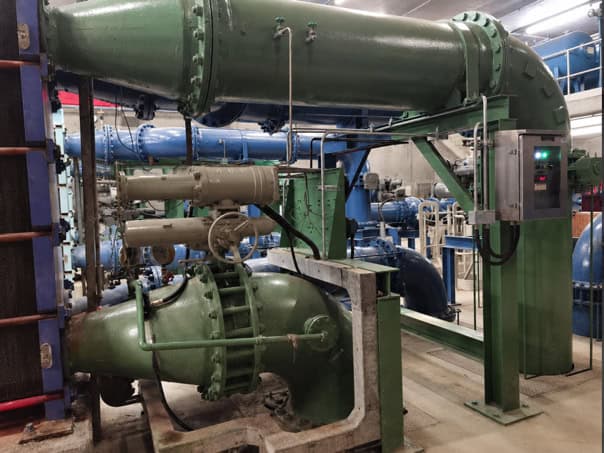
Hong Kong PHE: Treated Clear, Untreated Blocked 3 ft
A treated plate heat exchanger stayed largely unblocked over six months while its untreated twin blocked to 3 ft, holding 14-18% higher seawater flow.
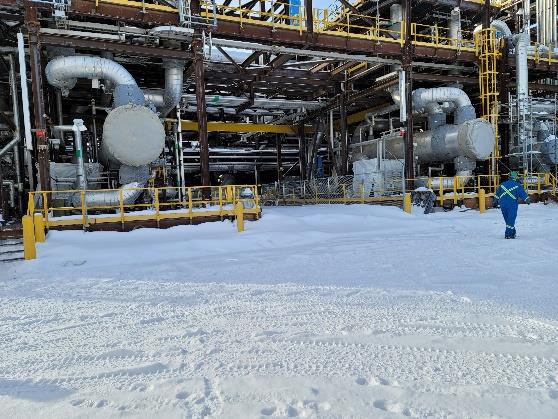
Imperial Oil Canada: Antiscalant Cut to 0.0 ppm
Three HydroFLOW Custom 24" units cut antiscalant dosing to 0.0 ppm at Imperial Oil's Kearl Lake facility in Canada.
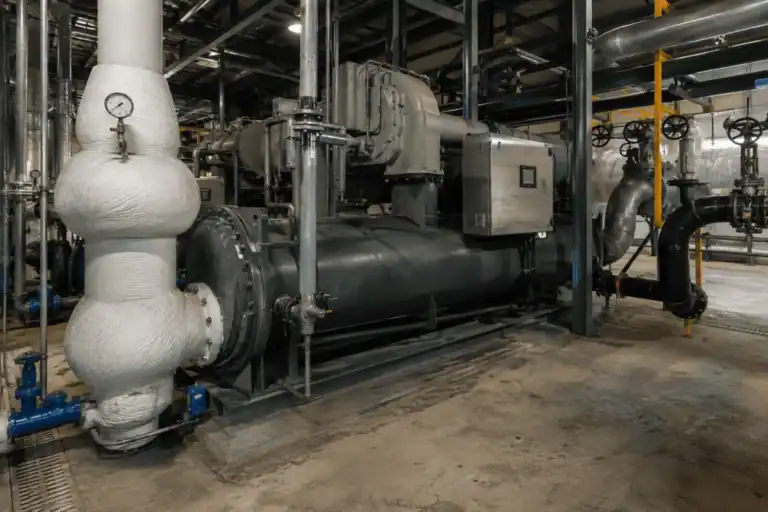
Hong Kong Seawater Chillers: COP Up 10-15%, Biofilm Removed
HydroFLOW treatment removed condenser biofilm and lifted COP 10-15% across five seawater cooled chiller plants.
Support & FAQ
Frequently Asked Questions
What is heat exchanger fouling?
Heat exchanger fouling is the build-up of unwanted deposits on heat transfer surfaces: mineral scale, biofilm, sediment and corrosion products. Even a thin layer insulates the plates or tubes, so the exchanger loses heat transfer, needs more pumping and energy, and has to be opened and cleaned more often.
HydroFLOW® works on two of those four, scale and biofilm. Sediment needs filtration, and corrosion has its own causes; microbiologically influenced corrosion is covered on our corrosion page.
What is the difference between fouling and scaling?
Scaling is one type of fouling: hard mineral deposits, mostly calcium carbonate, that form when heat drives dissolved minerals out of the water and onto a surface. Fouling is the wider term. It also covers biofilm and marine growth, silt, and corrosion products. In practice they arrive together: scale gives biofilm a rough surface to hold on to, and biofilm traps silt.
How do I know if my heat exchanger is scaled or blocked?
Watch the numbers you probably already log. Differential pressure rises across the plate pack or tube bundle, outlet temperature or approach drifts from design, flow falls or pumps run harder for the same duty, and cleaning comes round sooner. Slime, shells or grit at the strainers are an early sign too.
At a Hong Kong seawater plant, the untreated plate heat exchanger ran at higher differential pressure and lower flow than its treated twin, and was found blocked to a depth of 90cm (3 ft).
How often should heat exchangers be cleaned?
It depends on the water, the temperature and the duty, so there is no single interval, and your manufacturer’s inspection schedule still applies. The useful question is what stretches the interval. A Middle East hospital went from acid cleaning every three to four months to none in 17 months, and UBC Baton Rouge‘s fresh water generator ran three times longer between openings than it had on chemicals.
How do you remove scale from a heat exchanger?
The usual options are mechanical cleaning (strip-down, brushing, jetting) or chemical cleaning with acid, both with the exchanger offline. HydroFLOW® takes a slower route: once less new scale is forming, existing deposits soften and loosen over months. At a Ukrainian plant, existing scale was released progressively and the inspected flange showed no scale at ten months. On MV Hoegh America, only loose scale was left on the plates and cleaning took under two hours instead of 24 to 48.
If an exchanger is badly blocked today, clean it first, then use HydroFLOW® to help keep it clean.
How can you reduce scale and biofouling without chemical cleaning?
There are three physical routes. Take the hardness out before the exchanger (softening or RO), wipe the surfaces in service (automatic tube cleaning, tubes only), or change how minerals and biofilm behave so that less of either bonds, which is what HydroFLOW® does.
The strongest evidence for that last route is a controlled comparison: in Hong Kong, a treated and an untreated plate heat exchanger ran side by side on the same seawater for six months, and the treated one stayed largely open with 14–18% more flow. Most sites keep some chemistry. The aim is less of it, measured on your own records.
Does it work on plate, shell-and-tube and brazed plate heat exchangers?
Plate and shell-and-tube: yes, and the case studies cover both, from gasketed plate packs and marine fresh water generators to tube bundles, chiller condensers and power-station condensers.
Brazed plate exchangers cannot be opened for cleaning, which makes keeping scale out of them more valuable, but we have no brazed plate case study yet, so we make no performance claim for them. Air-cooled exchangers have no water side to treat, so HydroFLOW® does not apply.
Where is the unit installed?
On the supply pipe upstream of the exchanger. The unit installs around the outside of the existing pipe, and the signal travels through the water in both directions, so one unit can cover several exchangers on the same line. A Ukrainian plant protects two plate heat exchangers with one K40, and Enaex in Chile treats every branch of its seawater system from one unit 126 m upstream. Unit size depends on pipe diameter and flow.
Can it be fitted without shutting the exchanger down?
Yes. Nothing is cut into the pipe and nothing is drained, so the exchanger keeps running while the unit is fitted. A Middle East hospital installed two units with no downtime or plumbing changes, and MGEN Trois-Épis in France fitted twelve in one day without interrupting its hot water supply. That also makes a trial simple: one unit upstream of one exchanger, measured against your own logs.
Does HydroFLOW® replace chemical cleaning, antiscalant or biocide?
Not by default, and your water treatment contractor should make that call on your data. Some sites have reduced or stopped chemicals as a site result: Imperial Oil cut antiscalant from 2.0 to 0.0 ppm over a 12-month trial, and several ships ran their fresh water generators without dosing.
Closed-loop corrosion inhibitor stays where it is specified, and in food plants CIP frequency is set by your food-safety plan. Tims Dairy halved its milk-line cleans, a decision the site made on its own checks.
Do electronic water conditioners work on heat exchangers?
Scepticism is fair. Results vary, many low-cost devices are sold with no evidence behind them, and a conditioner does not remove minerals the way a softener does. HydroFLOW® is not a magnet or a wire coil: it induces a patented ~150 kHz signal into the water, and units are sized to the pipe and the duty.
The evidence we would ask you to weigh is a controlled comparison. On the same Hong Kong seawater circuit, the treated plate heat exchanger stayed largely open and carried 14–18% more flow, while the untreated one blocked to a depth of 3 ft. Then test it on one exchanger of your own.
Will loosened scale block anything downstream?
It can, for a while, so plan for it. As existing scale and biofilm loosen, the material travels with the water to strainers, filters and the exchanger itself, and plate channels are narrow. Check strainers more often in the first weeks, and inspect the plate pack or tube sheet at the next opportunity after install.
Sites have recorded this clearing phase: at a Kyiv brewery, filter deposits softened enough to rinse away, and at the Ukrainian plant, deposits were released gradually into the flow.
Ready to Clean Your Heat Exchangers Less Often?
Tell us about your exchangers: the type, the water on each side and how often you clean them now. Our team will recommend the right units, where they should go and what to expect, including where our assessment is that we cannot help.
Ready to explore sustainable water treatment?
Get in touch to find out how HydroFLOW® can work for you.

© 2026 Hydropath Technology Ltd. All rights reserved