Case Study from HydroFLOW Chile
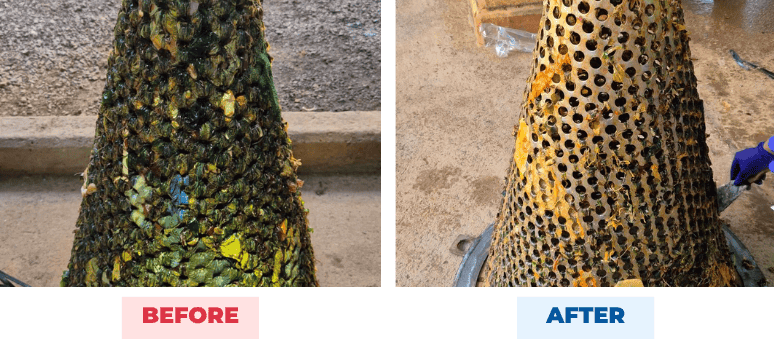
Seawater intake corrosion was undermining the seawater cooling system at Enaex’s ammonium nitrate production facility in Chile’s Antofagasta Region. The plant draws seawater through an intake line more than 100 metres long that branches to plate and tube heat exchangers. Microbiologically influenced corrosion (MIC) was building tubercles along the pipelines and strainers, severe biofouling was cutting exchanger efficiency, frequent openings for manual cleaning were needed, and corrosion control relied on high chemical use. One HydroFLOW® Multihead 52″ unit was installed on the main intake line on 12 November 2024 and monitored for 12 months. System openings fell 80%, MIC corrosion 90% and strainer biofouling 65%, chemical dosing was eliminated and annual savings reached $57k.
The Challenge
- Seawater intake corrosion (MIC) built up across the intake pipelines and strainers
- Severe biofouling affected the plate and tube heat exchangers, reducing efficiency
- Frequent shutdowns and system openings were needed for manual cleaning and inspection
- High chemical use was required for corrosion control
- Peak summer marine growth accelerated fouling and blockage
The Solution
- Unit installed: one HydroFLOW® Multihead 52″
- Installation point: main seawater intake line, 126 m upstream of the heat exchangers
- Pipe size: 1,320 mm OD
- Installed: 12 November 2024
- Monitoring period: 12 months, with laboratory validation in late 2025
The unit sits before the intake line splits to the heat exchangers, so one installation treats every branch. Performance was monitored across 12 months of seasonal conditions. An initial analysis in June 2025, at peak summer marine growth, showed a significant maintenance reduction, and laboratory validation in late 2025 confirmed the reduction in seawater intake corrosion and biofouling across the system.