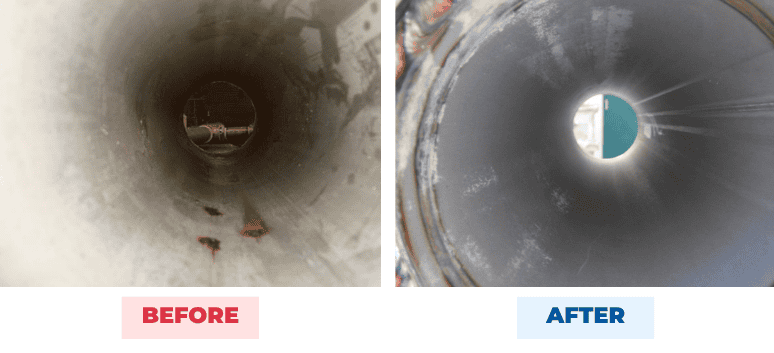
Microbial induced corrosion was putting the W3 starch line at Boise Paper’s mill in Wallula, Washington, at risk of internal pipe failure. Bacteria colonise the inside of steel pipework and build nodules, and the acids they produce attack the pipe wall until a nodule can become a pin-hole leak. One HydroFLOW® i120 was fitted to the line about three metres upstream of monitored test spool sections, some cut from contaminated pipe and some clean. Over a 15-week trial no new nodules formed, the existing nodules gradually broke down, and the clean pipe stayed free of new corrosion, with no chemicals on the line.
The Challenges
- Microbial induced corrosion was increasing the risk of internal pipe failure on the W3 starch line
- Bacteria were established inside existing nodules on the contaminated pipe
- Acids produced under the nodules were attacking the pipe wall from within
- Nodules could progress into pin-hole leaks
- Clean pipe needed ongoing protection so that new colonies did not take hold
The Solution
- Unit installed: one HydroFLOW® i120
- Installation point: W3 starch line, about three metres upstream of the test spools
- Pipe size: 5 inches outer diameter
- Trial: 15 weeks, with no chemical treatment on the line
To test whether microbial induced corrosion could be controlled without dosing, the unit was fitted upstream of spools cut from both contaminated and clean pipe. That showed two things at once: whether existing nodules changed and whether new ones formed. The spools were photographed at the start and at the end, with four individual nodules tracked on the contaminated pipe.