Seawater strainer cleaning interval at a Tasmanian zinc smelter
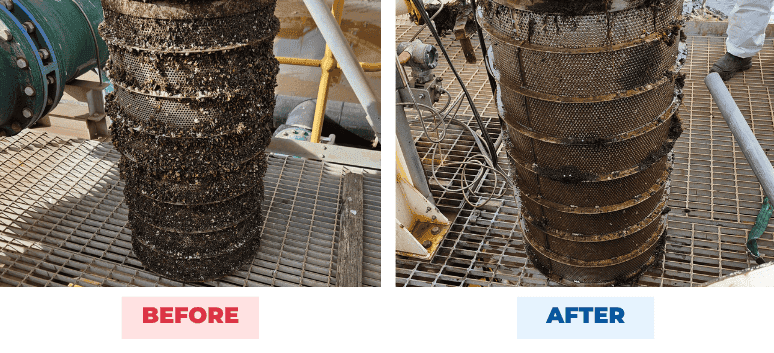
The seawater strainer cleaning interval at a zinc smelter in Tasmania had fallen to once every two weeks. Mussels and crustaceans attached to the pipework and strainers on three intake lines fed from the Derwent Estuary through 150 m of 400 mm pipe, and growth returned quickly after every hot soak and back flush. The system had to be treated at flows of at least 4,500 m³/hr. One HydroFLOW® Custom 16 inch unit was installed in mid-2023 before the manifold header and strainers, to act across all three lines. By the final inspection the high-flow sections were largely clean, with no mussels or crustaceans, and strainers ran four to five months between cleans.
The Challenge
- The seawater strainer cleaning interval had fallen to once every two weeks
- Mussels and crustaceans attached to the pipework and strainers
- Growth returned quickly after each round of cleaning
- Lines were hot-soaked and back flushed every two weeks
- Treatment had to cover flows of at least 4,500 m³/hr
The Solution
- Unit installed: one HydroFLOW® Custom 16 inch
- Installation point: before the manifold header pipe and strainers
- Pipe size: 400 mm, running 150 m from the Derwent Estuary
- Installed: mid-2023
- System: three intake lines, at least 4,500 m³/hr
Three underwater pumps feed water from the Derwent Estuary into a common header and strainers supplying gas scrubbers. Fitting the unit before that header let one installation act on all three strainers. The seawater strainer cleaning interval was the measure the trial was judged on. Early inspections still showed marine growth despite cleaning, and performance improved as the trial went on.
Testimonial
“There are still signs of sea grass on some housing, but high-flow areas remained clean, and importantly mussels and crustaceans were not observed.” — Customer inspection feedback