Struvite in wastewater may be a familiar problem to operators, but its true cost is often measured in blocked pipework, disrupted dewatering, premature equipment wear and repeated maintenance. Since I began working directly with the wastewater treatment industry in 2018, I have seen how a relatively simple, non-invasive intervention can help operators bring this difficult scale under control.
By Guy Dinsdale, Technical Services Manager, Hydropath Technology
Why struvite in wastewater becomes a serious operational problem
Struvite is magnesium ammonium phosphate hexahydrate, a crystalline mineral that can form when magnesium, ammonium and phosphate are present under favourable conditions. In wastewater treatment, it is particularly troublesome because it deposits as a hard scale on pipework and process equipment. Research referenced by the US Environmental Protection Agency confirms that magnesium, ammonium, phosphate and pH all influence struvite formation.
The problem is not confined to one component. Struvite can restrict centrate lines, clog valves and pumps, blind the mesh on belt presses and build up inside centrifuges.
- ✗Restricted centrate linesReduced flow and a greater risk of blockages.
- ✗Clogged valves and pumpsMore cleaning, disruption and emergency maintenance.
- ✗Blinded belt-press meshPoorer filtration and dewatering performance.
- ✗Centrifuge depositsImbalance, vibration and additional mechanical strain.
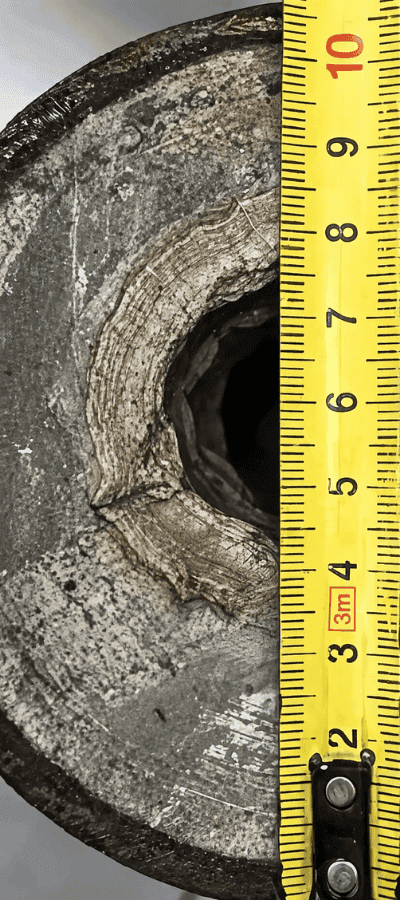
Each of those effects creates its own operational penalty: reduced flow, poorer dewatering, higher energy demand, more cleaning and, ultimately, more downtime.
A centrifuge makes the maintenance challenge especially clear. The drum is a very large rotating mass, commonly operating at high speed. If scale forms unevenly inside it, the resulting imbalance can increase vibration and place additional strain on bearings and other mechanical components.
Removing hard deposits may require acid or mechanical cleaning and, in some cases, lifting the drum out with a crane. Even where a site has duty and standby equipment, taking a machine out of service reduces resilience and creates a substantial maintenance burden.
What my role brings to a wastewater project
I trained in integrated engineering and began my career in aviation, working with safety-critical equipment including rescue hoists, searchlights and helicopter medical interiors. I have now spent more than ten years with Hydropath.
As Technical Services Manager, my role combines technical sales with practical support for distributors and customers around the world: understanding the process, identifying the right installation point, supporting product trials and helping each site achieve the strongest defensible result.
My direct work with wastewater treatment began in 2018. Since then, I have worked alongside operators, dewatering specialists and HydroFLOW distributors in the UK, the USA, Australia and other markets.
That network matters. Wastewater varies by site and season, and the same symptom can have different causes. Good technical support means recognising both where the technology is likely to help and where site conditions, such as very low flow in a gravity-fed line, may limit the result.
Good technical support means recognising both where the technology is likely to help and where site conditions may limit the result.
A practical approach to struvite treatment
HydroFLOW® installs externally around a pipe, so the pipe does not need to be cut and the treatment process does not need to be stopped for installation. The unit applies an electrical signal through the pipe and its contents.
Under suitable hydraulic conditions, the aim is to encourage minerals to form suspended crystals rather than adhering to equipment as hard scale. Flow then carries those crystals onward. Over time, HydroFLOW® can also help soften and reduce existing deposits.
Where possible, I recommend beginning a trial from a clean baseline. Scale changes slowly and wastewater composition fluctuates, so a meaningful struvite trial will often need to run for several months.
- 1Establish the baselineRecord where scale forms, how quickly it returns and what cleaning is currently required.
- 2Select the installation pointReview the pipe configuration, flow conditions and equipment requiring protection.
- 3Define the test periodAllow enough time to cover normal changes in feed and operating conditions.
- 4Measure the outcomeCompare new scale formation, existing deposits, cleaning requirements and process performance.
Struvite removal methods compared honestly
There is no single method that suits every wastewater facility. Acid cleaning and mechanical removal have a legitimate place where hard deposits must be removed immediately. Chemical inhibitors may also be appropriate where a site already has suitable dosing and control infrastructure.
Physical water conditioning takes a different approach. Instead of waiting for hard scale to form and then removing it, the objective is to reduce surface deposition continuously. The most suitable option depends on the urgency of the blockage, the process conditions, access, safety requirements and the site’s maintenance strategy.
| Acid cleaning | Mechanical / hydro-jetting | Chemical inhibitors | HydroFLOW® | |
|---|---|---|---|---|
| What it does | Dissolves hard deposits after they form | Physically breaks and flushes deposits out | Dosing intended to limit new crystal formation | Conditions minerals so less hard scale adheres |
| Existing deposits | Yes, aggressively | Yes, where access allows | No | Yes, gradually under suitable flow |
| Disruption | Downtime and chemical handling | Access and downtime required | Low once dosing is set up | None; installs on the pipe without cutting |
| Ongoing cost | Every clean | Every clean | Continuous chemical spend | None after installation |
| Best for | Urgent removal of hard deposits | Seriously restricted lines | Sites with dosing and control infrastructure | Continuous whole-line control |
| Watch out for | Material compatibility and safety controls | Risk of pipe damage; access needed | Dosing control and wastewater impact | Needs suitable flow; confirm with a site trial |
What the field evidence looks like
One of the clearest independent assessments was carried out at the Robert W. Hite Treatment Facility in Denver. In a 60-day verification, CH2M reviewed sampling data, visual observations and plant feedback after HydroFLOW I Range units were installed on the centrate line.
CH2M reported that the treatment prevented new scale formation at the transfer pump and pipe and softened existing scale so that flowing liquid could remove a substantial portion of it. Following the test, the facility purchased four units for its centrate and digested-sludge lines.
A case study from Walla Walla, Washington, provides a useful on/off comparison. With HydroFLOW operating, a cleaned belt-press drum section remained free of new scale for eight weeks and existing deposits softened. When the unit was switched off, hard scale returned. That reversal is valuable because it makes the treatment effect visible on the same equipment under site conditions.
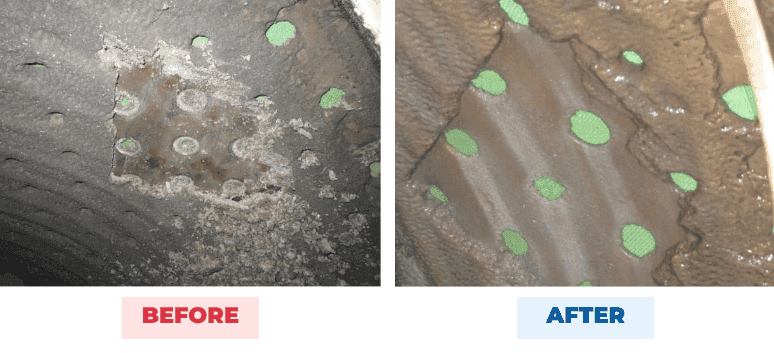
Belt press drum test section at the City of Walla Walla plant, before and after treatment.
Thames Water East Hyde: no new scale during a six-month trial
At Thames Water’s East Hyde Sewage Works in Luton, severe struvite scaling in the primary centrifuge centrate lines was causing frequent maintenance. Scale returned within weeks of cleaning, and the site had been forced to redirect the flow through a bypass pipe.
A HydroFLOW® unit was installed externally around the sludge feed pipe in the ceiling of an adjacent building, where access and power were available. During the six-month trial at East Hyde Sewage Works, the centrate line showed no additional scale formation. The site also reported reduced maintenance requirements, longer service intervals and improved centrifuge operation.
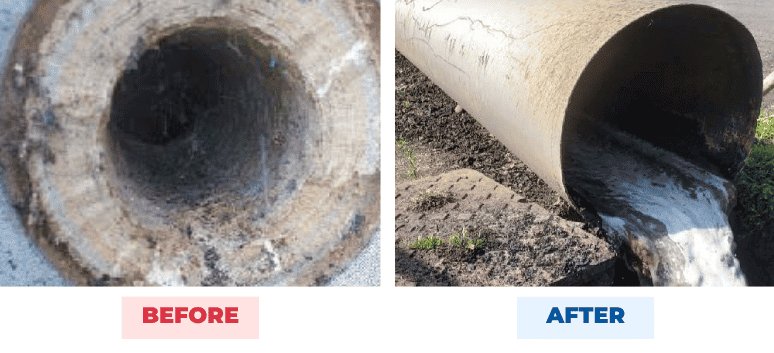
Thames Water’s East Hyde Sewage Works reported no additional struvite scale during the six-month trial.
The wider gains: polymer, energy and maintenance
Struvite control is the primary focus, but a well-chosen HydroFLOW installation can influence other parts of sludge dewatering.
At Banbury wastewater treatment works, a belt-press trial recorded a polymer saving of 200 litres per hour while maintaining 18% cake solids. At Yorkshire Water’s Esholt site, matched centrifuge runs reduced polymer use by 11% while maintaining output quality.
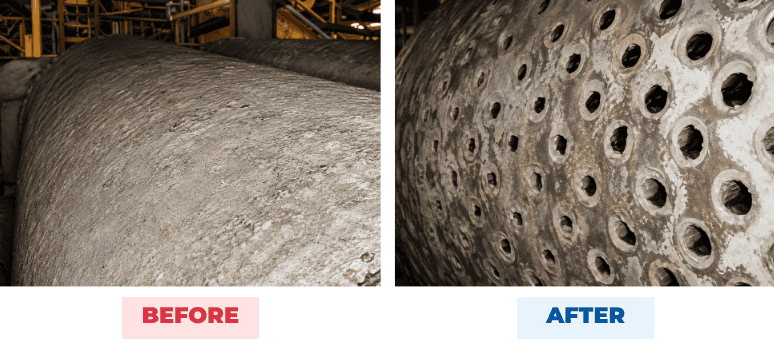
Belt press drum at another US wastewater facility, before and after treatment.
Polymer acts rather like a glue, bringing fine solids together into larger flocs so that water separates more readily. It is essential to many dewatering processes, but it is also a significant ongoing cost. If equivalent output can be achieved with a lower dose, the operator reduces both expenditure and the amount of added chemical carried into the dewatered solids.
Energy can benefit too. During detailed work at Yorkshire Water’s Esholt site, the treated line showed a higher differential RPM, indicating lower centrifuge stress. That result should not be presented as a universal energy-saving figure, but it illustrates why the best evaluation looks at the whole process rather than scale alone.
For most operators, however, the greatest value remains maintenance: longer intervals between cleaning and service, fewer blockages, less emergency work and more dependable equipment availability.
Start with the site, not with a blanket promise
No responsible engineer should claim that one result will be reproduced everywhere. The CH2M memorandum itself recommends site testing to demonstrate technical and financial feasibility under each facility’s conditions. I agree.
Flow, pipe configuration, wastewater chemistry, seasonality and the point of installation all matter.
That is why our support begins with the problem: where the struvite is forming, how quickly it returns, what cleaning is currently required, what the flow conditions are and how success will be measured.
From there, we can define a sensible installation and a trial long enough to separate a real operational improvement from a short-term fluctuation.
The objective is not a quick photograph after a few clean weeks. It is to establish whether the improvement continues through normal operating conditions.
A low-disruption route to a persistent problem
Wastewater operators do not need another technology that creates a complicated installation project. HydroFLOW can be retrofitted without cutting pipework and without interrupting the treatment process.
Where the application is suitable, it begins working immediately and can address the central struvite problem while also creating opportunities to optimise polymer, energy and maintenance.
After eight years working directly with wastewater sites, my strongest advice is straightforward: do not accept repeated blockages and cleaning as an unavoidable cost of operation. Establish the baseline, choose the right point of treatment and test the result properly. Struvite may be persistent, but it can be managed.
Frequently asked questions about struvite in wastewater
What causes struvite formation?
Struvite formation occurs when magnesium, ammonium and phosphate are present in suitable concentrations and the chemical conditions favour crystallisation. Factors including pH, concentration, temperature, turbulence and changes in pressure can influence where deposits form.
In wastewater treatment, these conditions are often found around anaerobic digestion, sludge dewatering and centrate return systems. The research referenced by the US EPA identifies the concentrations of the struvite-forming ions and pH as important variables.
How do you break down struvite?
Existing struvite can be removed using acid cleaning, mechanical tools or specialist cleaning products. The appropriate method depends on the deposit, equipment material, access and site safety requirements.
HydroFLOW takes a preventative and gradual approach. It installs on the pipe and aims to reduce adhesion while helping existing deposits soften under suitable flow conditions. Results should be confirmed through a site trial rather than assumed.
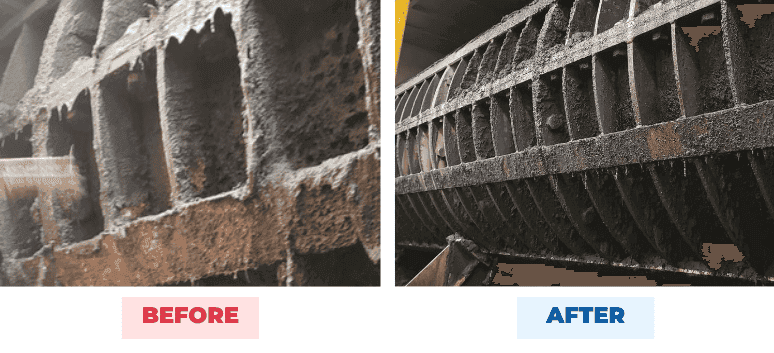
Hard and soft struvite inside a screw press, before and after treatment.
What is struvite in wastewater?
Struvite in wastewater is a crystalline mineral called magnesium ammonium phosphate hexahydrate. It can form as a hard deposit in pipes, pumps, valves, centrifuges and belt presses, restricting flow and increasing cleaning and maintenance.
Hydropath’s struvite application overview explains where the mineral commonly forms and how physical water conditioning is used to control deposition.
How do you remove struvite from pipes?
Hard struvite in pipes may be removed by acid cleaning, hydro-jetting or mechanical cleaning. These methods can be necessary when a pipe is already seriously restricted, but they normally require access, safety controls and some disruption.
For continuous control, HydroFLOW installs externally around the pipe and aims to reduce new hard deposits while helping existing scale soften. During the 60-day Robert W. Hite facility trial, CH2M reported no new scale at the transfer pump and pipe, together with softening and partial removal of existing deposits.
Is there a chemical that removes struvite?
Chemical approaches include acidic cleaners for existing deposits and inhibitors intended to limit new scale. They can be effective, particularly when rapid removal is required, but chemical handling, compatibility, dosing control, recurring cost and wastewater impact must all be considered.
Physical conditioning is a non-chemical alternative for suitable flowing systems. It does not make emergency mechanical or chemical cleaning unnecessary where a pipe is already blocked, but it may reduce the rate at which hard deposits return.
What should you use as a struvite scale remover?
A struvite scale remover may refer to an acidic cleaning product, a mechanical cleaning method or a treatment intended to limit further deposition. Before choosing one, confirm the deposit composition and check compatibility with the pipework and equipment.
In the Walla Walla trial, existing pan deposits softened enough to wash away with a hose after eight weeks of HydroFLOW operation. When the unit was switched off, hard scale returned.
Which HydroFLOW unit is suitable?
The correct unit depends on the pipe diameter, pipe material, flow conditions, installation point and the equipment requiring protection. Wastewater and sludge-dewatering applications commonly use the commercial and industrial HydroFLOW ranges, including the I Range and Custom Range.
Explore Hydropath’s water and wastewater treatment overview or contact the Hydropath technical services team to discuss the pipework, current cleaning schedule and a measurable site trial.
If struvite is restricting your pipework, pumps or dewatering equipment, contact Hydropath to discuss a site assessment with Guy Dinsdale and the technical services team.
Sources and further reading
- Robert W. Hite Treatment Facility struvite control case study.
- Hydropath: Walla Walla struvite scale prevention case study.
- Hydropath: Luton wastewater treatment works struvite case study.
- Hydropath: Yorkshire wastewater treatment works polymer reduction case study.
- Sydney Water: Dewatering Equipment Design Specification update (March 2026).
- US EPA HERO: Study of nutrient removal through struvite formation.