When people think of agriculture, they often picture crops in a field. After working in water treatment for 16 years, I tend to think about the water moving through the whole operation: from a borehole to an irrigation nozzle, through a livestock drinking line, or into the systems that wash, cool and process food. Each of those stages can present a different water treatment problem. For sites looking to manage scale or biofilm without increasing chemical dosing, this is where chemical-free water treatment for agriculture can be worth exploring.
By Dr Denzil Rodrigues, Head of Innovation, Hydropath Technology
I came to Hydropath from a physics research background at the University of Nottingham. Even now, there is still more to discover in water treatment. I find that the most useful starting point is to define a specific problem and a way to measure whether an intervention has helped.
Water itself is also becoming a bigger concern for farmers and growers. The Environment Agency’s 2026 agriculture and water report describes secure and reliable water supplies as vital for food production and food security, particularly as drought and climate pressures affect agricultural water resilience.
A range of problems means a range of opportunities, and I would like to do more work with UK farmers and growers exploring them.
Universal problems, and those unique to agriculture
Many agricultural applications look much like those in other industries. A food processing site may have boilers producing hot water or steam, heat exchangers and cooling towers, just like any other manufacturing site. Limescale on heat transfer surfaces can affect performance and maintenance; cooling circuits can face biofilm, especially when the water used is not treated municipal water. In one peer-reviewed study, published in Experimental Thermal and Fluid Science, HydroFLOW was used successfully to treat the plate heat exchanger of a turbine cooling system in a hydroelectric power station. Coming from a river, the water shared the higher biological load that is often seen with agricultural water. Both scale and biofilm are established reasons for us to look at a water system, whether the site happens to be handling produce or any other manufactured product.
As we move closer to the crop or livestock, the detail changes. Irrigation systems and sprays can have small nozzles and valves that are particularly vulnerable to scale. In poultry houses, drinking lines have similarly small outlets, while water can sit or move slowly through parts of the network. Scale and biofilm can both have a disproportionate effect there.
We have worked with these applications as well as growers using irrigation in greenhouses and for flowers. The water source, the distribution layout and the actual maintenance problem determine where to start.
- ✓Blocked irrigation emittersSmall openings can be particularly vulnerable to mineral scale and deposits.
- ✓Biofilm in drinking linesSlow-moving or standing water can allow biofilm to establish inside the system.
- ✓Scale on heat-transfer equipmentBoilers, heaters and heat exchangers can face the same scaling problems seen in other industries.
- ✓Borehole water problemsThe water source itself can introduce mineral or biological challenges.
- ✓Recirculated process waterReuse reduces water demand but makes water quality and biological control increasingly important.
Where chemical-free water treatment for agriculture fits
Once we move away from auxiliary systems like cooling towers or heaters and look at water that will be used in production, or will be used for livestock or crops, there is an additional factor specific to agriculture: the permissible amount of chemical treatment in the water is often limited, or even zero.
A physical water treatment approach can be of particular interest where a grower or processor is seeking to manage deposits or biofilm without increasing chemical dosing. Of course, it does not replace hygiene controls or the need to monitor water quality, but it can provide an additional treatment option where other approaches are constrained.
HydroFLOW® is an electronic water conditioner that installs on the pipe and works without adding treatment chemicals to the water. That makes it particularly relevant where water is going directly to crops, livestock or food processing.
For a broader overview of applications, see Hydropath’s agricultural water treatment page.
Irrigation nozzles, emitters and livestock water lines
Small nozzles and emitters make irrigation particularly sensitive to deposits. A level of scale that may have little effect in a larger pipe can become enough to affect a drip emitter, spray nozzle or small valve.
So when drip emitters keep clogging or nozzles keep needing cleaning, the first step is to find out whether the restriction is caused by mineral scale, suspended material, biofilm or a combination of these. Hard water clogging drip irrigation is common, but it is not the only cause.
Biofilm is also a recognised problem in irrigation networks. A 2026 peer-reviewed review of biofilms in agricultural irrigation networks identifies biofilm as a cause of emitter clogging and microbially influenced corrosion (MIC), and notes that chemical biocides, while cheap in the short term, carry long-term risks of resistance and ecotoxicity.
Hydropath has published an irrigation case study from a Cycas nursery in Italy where the operator had been dismantling and chemically cleaning sprayers because of limescale. After treatment, the site reported that sprayer blockages stopped and irrigation pressure remained stable.
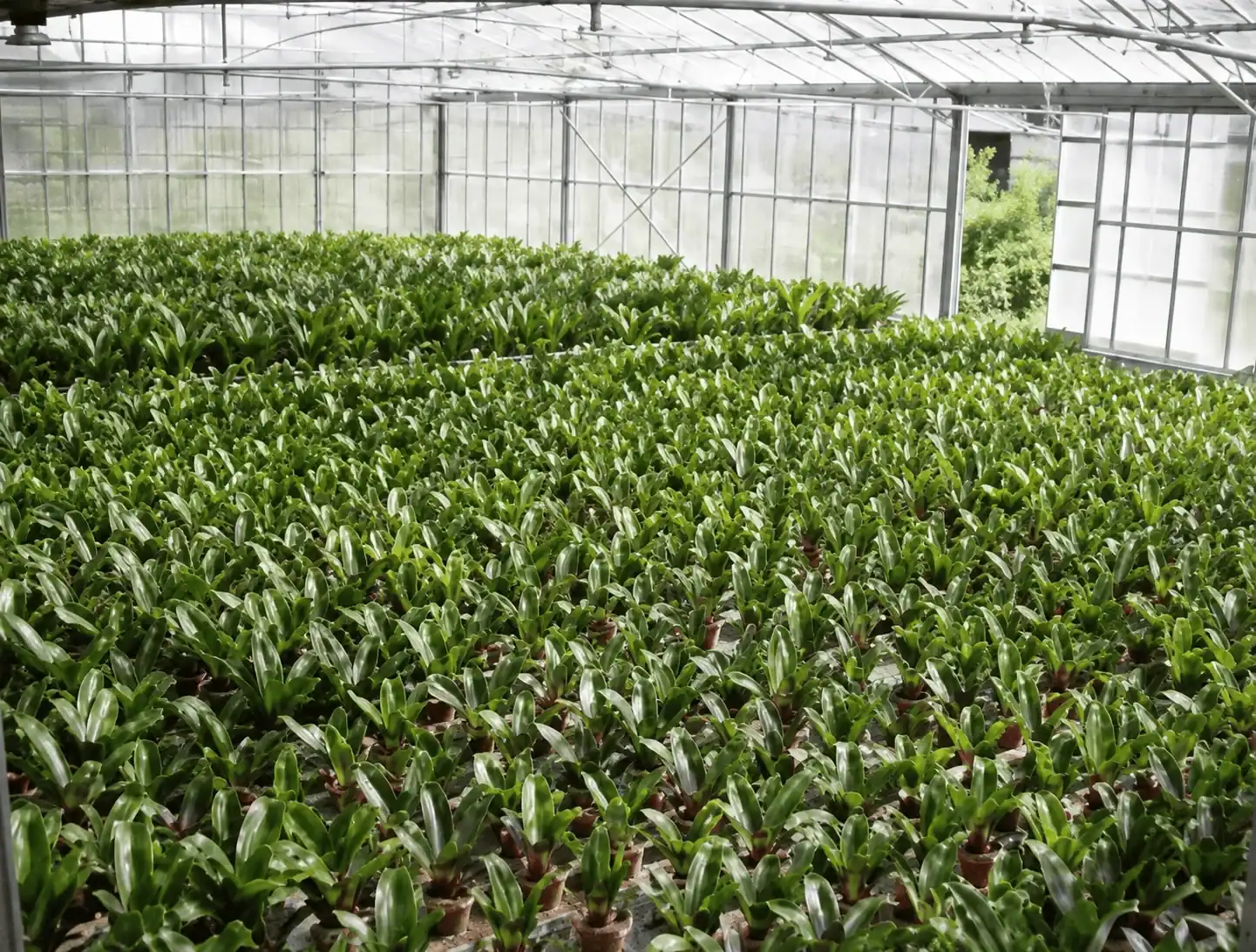
The Cycas nursery in Italy, where small sprayers and valves had been blocking with limescale from hard well water.
The same principle applies to livestock water treatment. Poultry drinking lines have similarly small outlets, and recent research into biofilm in poultry drinking water lines has shown that persistent biofilms can act as reservoirs of microbial contamination. Physical water treatment does not replace poultry water line sanitation or microbiological monitoring, but it can form part of the approach where scale or biofilm is contributing to the problem.
Fruit and vegetable washing and water reuse
Fruit and vegetable washing is a good example of an application where physical treatment can play a unique role. A wash line may filter and recirculate produce wash water rather than discard it after every pass. That makes water use more efficient, but it also creates conditions in which biofilm and microbial levels need attention, and where chemical treatment can only go so far.
By controlling biofilm, HydroFLOW® can help keep bacterial levels down without increasing chemical use. At a US apple packhouse, an independent consultant recorded microbial counts holding at non-detect while the chlorine dose was cut from 40–50 ppm to 10 ppm. When the unit was switched off, counts became detectable again at the same dose. That kind of on-and-off comparison is always particularly striking.
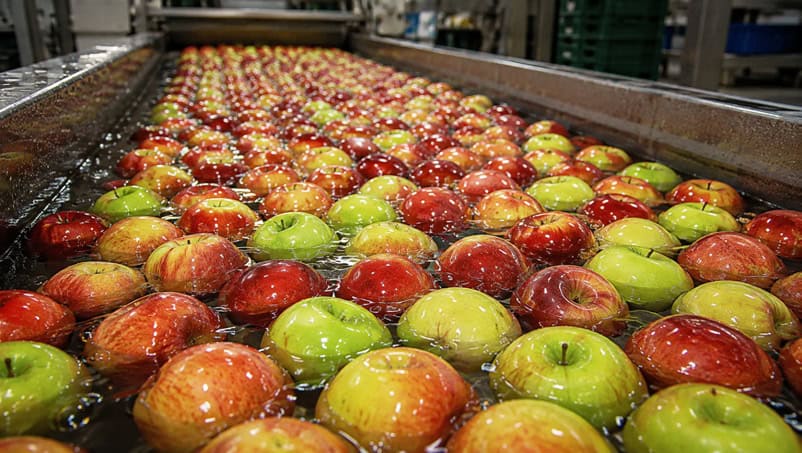
Recirculated produce wash water requires both microbial monitoring and effective control of biofilm.
Any wash water recycling scheme needs to be considered as part of the whole hygiene programme. HydroFLOW does not replace sanitiser dosing, food-safety controls or microbiological testing.
Beyond water treatment: milkstone in dairy processing
HydroFLOW® can treat the product line itself, as well as just water. At Tims Dairy, a HydroFLOW unit installed on the milk line ahead of the plate heat exchanger took the line from two acid cleans a week to one, with each clean using half the phosphoric acid.
Dairy processing brings a different deposit to the usual limescale. Milkstone, sometimes called “milk scale”, contains a mix of minerals, proteins and other biological material and can build up on pipework, valves and heat exchangers. This is a problem unique to agriculture and food production that can be difficult to address simply by treating it as conventional limescale.
Research backs this up. A peer-reviewed review of fouling during the heat treatment of milk, by researchers at FrieslandCampina and Wageningen University & Research, identifies heat-induced protein destabilisation and calcium phosphate precipitation as the main drivers of milk fouling.
We have encountered milkstone in dairy applications over many years and treated it successfully. A published dairy farm case study from Panama is one example, where treatment was used on the water heating and raw milk pipe cleaning system.
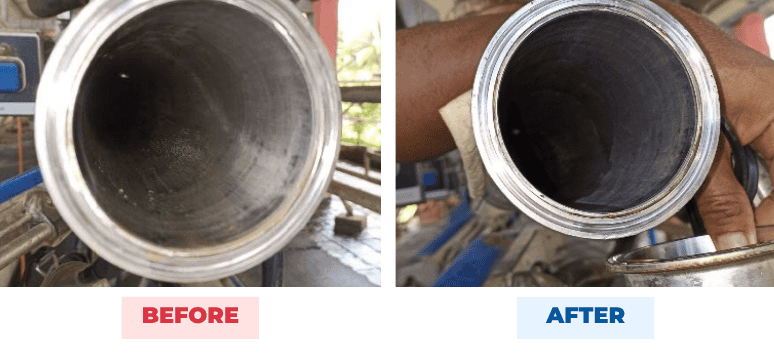
Milk scale in food-factory pipework, before and after HydroFLOW treatment. This is a separate site from the dairies named above.
Dissolved air flotation and flocculant use
As well as the product line, we can also help treat waste.
We have applied HydroFLOW alongside dissolved air flotation (DAF) systems, which use fine bubbles to bring suspended material to the surface for removal. These systems often use a flocculant to help particles come together.
In applications we have seen, treatment has helped the process work with less flocculant. Hydropath has published DAF installations, such as a flotation plant at an Italian meat processor and Maple Leaf Foods in Canada, where operators have been able to reduce flocculant and coagulant use while maintaining or improving separation performance.
Wastewater systems can also suffer from their own specific type of mineral deposit, but that is a story for another blog. The right question for any new site is how much difference can be demonstrated under its specific operating conditions.
Treating the root cause: borehole water and MIC
One of our recent examples is an olive grove in the Middle East supplied by boreholes. The operator had reported orange-coloured water associated with a corrosion problem and had to run water until it cleared, wasting a lot of water in a region where water is not cheap.
The root cause of the corrosion was not simply chemistry, but biology. Microbially induced corrosion (MIC) occurs when microbial activity contributes to corrosion of metal surfaces. Biofilm and microbial deposits can therefore be part of a corrosion problem rather than simply a separate fouling issue.
Following installation of HydroFLOW on the wells, the customer reported that this recurring problem had not appeared during the first several months of observation. The published Al Jouf irrigation case study compares treated and untreated wells: on the treated wells, flushing at restart fell from 30 minutes to 2 and flushing intervals stretched from 5 days to 20.
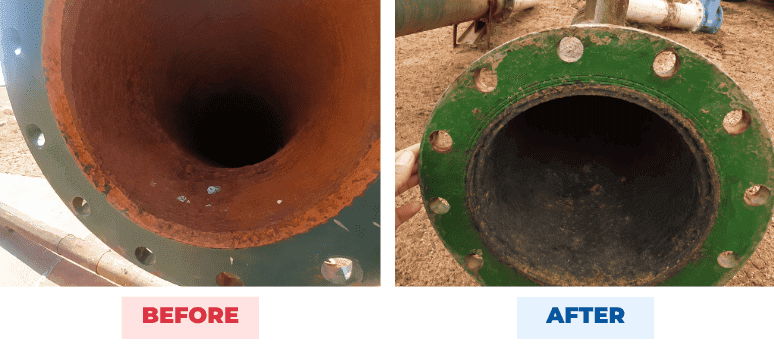
Well pipework at the Al Jouf olive grove, before and after HydroFLOW. Treated and untreated wells were compared over the monitoring period.
We want to keep this borehole water treatment application under observation for longer to account for seasonal variation. The early results are encouraging, but longer monitoring gives us a better basis for judging the outcome.
Fish farming and recirculating aquaculture systems
Fish farming is another application where biofilm can lead to subsequent problems. A recirculating aquaculture system (RAS) continuously reuses water, so water quality, solids, nutrients and microbial populations need close management. A peer-reviewed review of microorganisms in recirculating aquaculture systems explains that RAS depend on diverse microbial communities for water purification, while some microorganisms can also cause unwanted effects.
Recirculating, nutrient-rich water can encourage biofilm, while chemical choices are constrained by the animals in the system. This makes biofilm control an important consideration in water treatment for fish farming and wider aquaculture water treatment.
We have seen encouraging results, including lower bacterial readings and fewer infection symptoms in trials.
One example is a 90-day AquaVet Technologies trial in a recirculating system of four 10 cubic metre tanks, each stocked with 300 hybrid tilapia, with infected fish held in disease reservoir tanks. HydroFLOW treated the incoming water to one healthy tank, Tank IV. At day 90, Tank IV had the highest survival of the four tanks, at 74%, along with lower bacterial counts and fewer infection symptoms.
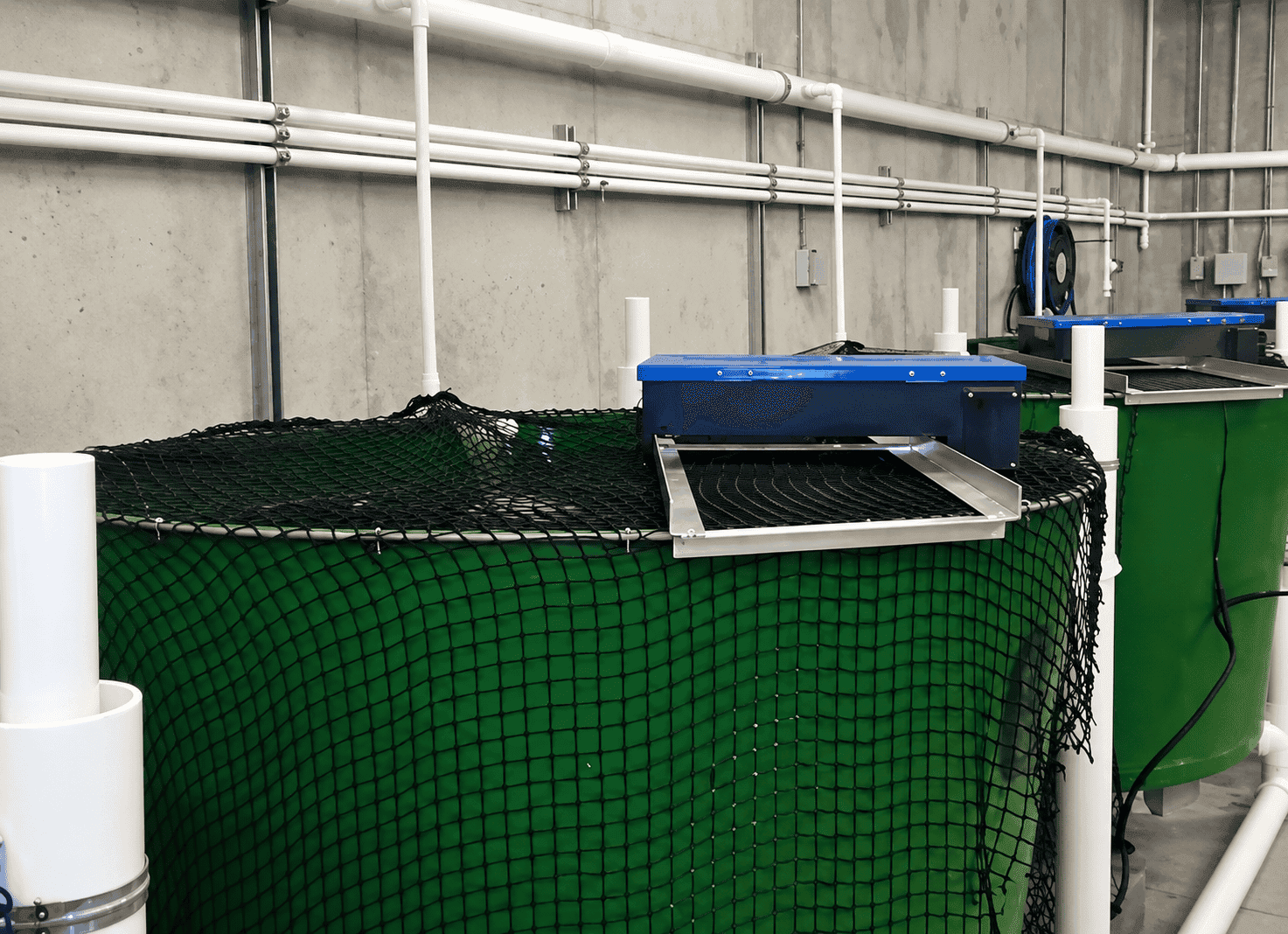
Tanks from the AquaVet recirculating tilapia trial, which evaluated HydroFLOW over 90 days.
We also have a commercial example from Civitavecchia Fish Farm, a seawater farm near Rome. HydroFLOW units replaced the existing UV systems in two phases across the hatchery, breeding pools and main hall. The farm reported more than two and a half years without bacterial or viral infections, together with clearer water and lower running costs.
These results are encouraging, but different aquaculture systems have different biology and operating conditions, so I would still want consistent monitoring across more sites before drawing broader conclusions about water treatment for fish farming as a whole.
As that review shows, not every biofilm in a RAS is undesirable. Biological filtration itself relies on microbial communities, so treatment needs to target unwanted fouling without confusing it with the beneficial biology required by the system.
Exploring new areas
Often, one application leads to new potential avenues. In some irrigation projects, people have noticed changes in crop growth or the amount of water used alongside the expected work on scale or biofilm.
There are possible explanations, including changes in how water penetrates into the soil, but we do not yet know which explanation applies or whether the observations will hold across settings. It would be premature to promise a yield increase or water saving on that basis.
This is where my research background comes in.
The published research on the technology itself is so far mostly laboratory work on scale. A peer-reviewed review in npj Clean Water concluded that, in the majority of laboratory, pilot and full-scale studies, electromagnetic field treatment encourages minerals to crystallise in the water rather than stick to pipe and vessel walls. A 2025 University of Louisville study tested a HydroFLOW unit on heating elements in very hard water and found the treated scale was easier to remove, with a visibly different crystal structure. Neither was carried out on a farm, which is why well-designed agricultural trials are the next step.
A controlled growing environment, such as a greenhouse, can make comparisons more informative because water use, growing conditions and crop performance can be monitored. I would be interested in greenhouse water treatment trials that first document a defined scale or biofilm problem and then track maintenance, water quality and, where appropriate, water penetration and plant outcomes before and after installation or against a comparable untreated area.
Our rose greenhouse case study, where the grower measured longer stems after installation, is a promising sign. It was a before-and-after evaluation rather than a controlled trial, and that is exactly why I would like to run one.
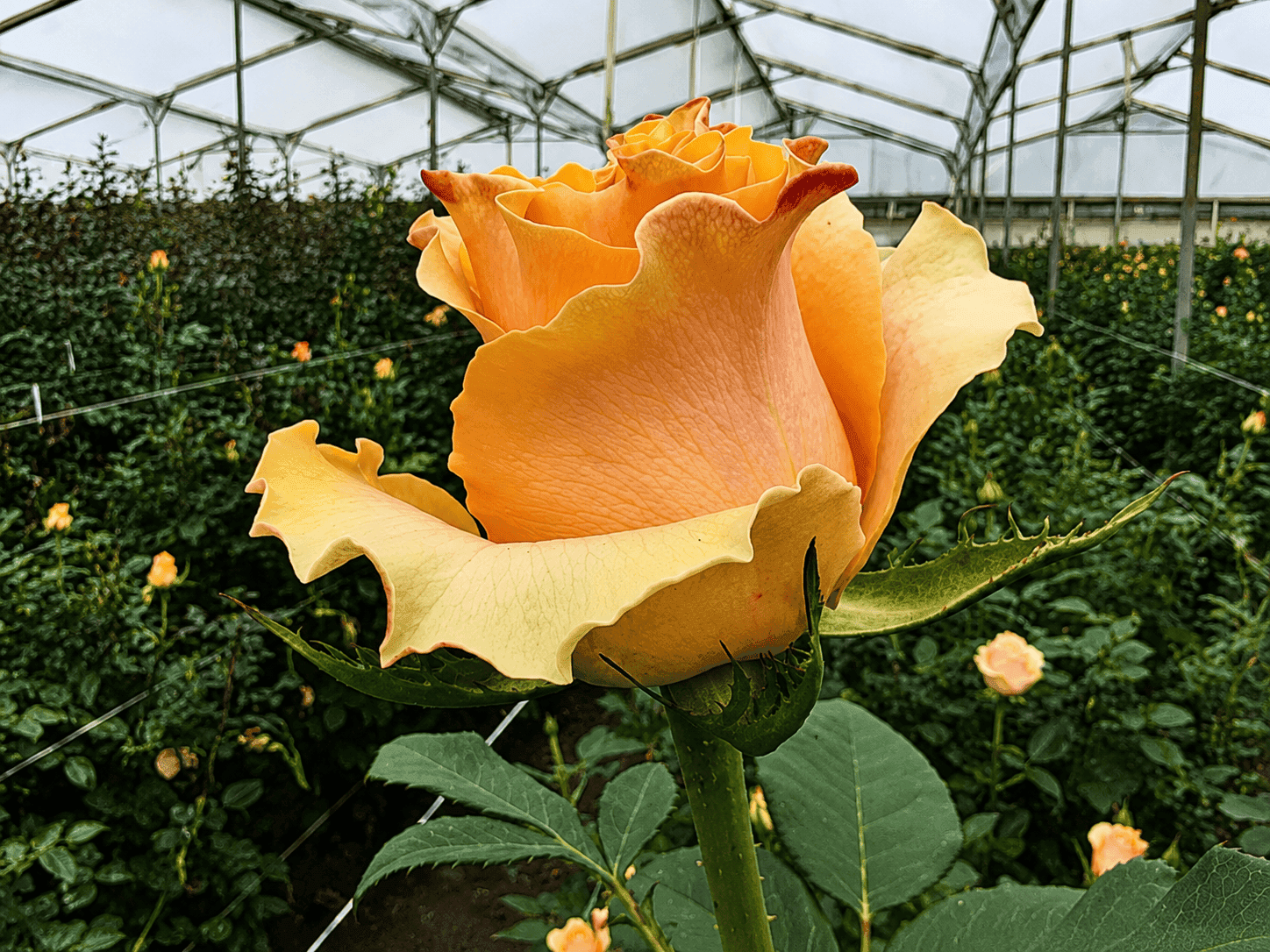
Long-stem rose production at the South American greenhouse. Controlled growing environments make it easier to monitor irrigation conditions and plant outcomes over time.
Even a result that shows no meaningful difference would teach us something about where the technology is best used. That is important if chemical-free water treatment for agriculture is going to be applied on the basis of evidence rather than assumption.
The most valuable starting point is a real operational question that we can test together.
Published examples across agriculture and food processing
- →
Italy Cycas NurseryIrrigation sprayers had required dismantling and chemical cleaning before treatment. The operator later reported no further sprayer clogging and stable irrigation pressure.
- →
US Apple FlumeMicrobial counts held at non-detect while chlorine was cut from 40–50 ppm to 10 ppm in recirculated produce wash water.
- →
Tims DairyA unit on the milk line ahead of the plate heat exchanger halved both the number of milk-line cleans and the acid used in each.
- →
Panama Dairy FarmMilk scale remover use fell from 900 ml to 700 ml and the chemical cleaning interval stretched from 15 to 22 days, saving $803 a year.
- →
Al Jouf Olive GrovesAgainst an untreated well, flushing at restart fell from 30 minutes to 2 and flushing intervals stretched from 5 days to 20.
- →
AquaVet Tilapia TrialIn a 90-day recirculating trial, the HydroFLOW-treated tank had the highest survival of four tanks, at 74%, with lower bacterial counts.
- →
Civitavecchia Fish FarmHydroFLOW replaced UV systems, and the farm reported more than two and a half years without bacterial or viral infections.
Frequently asked questions
Why do my drip emitters keep clogging?
Drip emitters can clog because of suspended solids, mineral deposits, biological growth or a combination of these. Filtration is the answer where sand or physical debris is the problem. Where hard-water scale or biofilm is contributing, the water itself and the conditions inside the irrigation line need to be addressed. Hydropath’s Italy nursery case study is an example involving repeated mineral blockage of irrigation sprayers.
How do you get rid of biofilm in water pipes?
There is no single answer for every system. Cleaning, flushing, disinfection and ongoing water management may all be required depending on the application. HydroFLOW is designed to help disrupt unwanted biofilm formation, but it does not replace hygiene procedures, disinfection or water-quality monitoring. See Hydropath’s biofouling and biofilm guidance.
What does milkstone look like?
Milkstone does not have one reliable appearance because its composition varies with the dairy process and operating conditions. More importantly, it is not simply ordinary hard-water limescale. Dairy fouling can contain mineral and organic material, so the deposit should be considered alongside the process and cleaning history rather than identified by colour alone.
What are the signs that iron bacteria are present?
Orange or rust-coloured water, slime, deposits and recurring corrosion can indicate an iron-related or biological problem, but none of these signs proves the cause by itself. Investigation of the water and pipework is needed before concluding that iron bacteria or microbially induced corrosion is responsible. The Al Jouf borehole case study is one example where biological fouling was associated with a recurring corrosion problem.
Is biofilm bad for fish?
Not automatically. Beneficial microbial communities are an essential part of biological filtration in many recirculating aquaculture systems. The problem is unwanted biofilm on pipework and equipment where it can harbour microorganisms, restrict flow or affect water-system hygiene. Any treatment therefore needs to distinguish useful biological filtration from unwanted biofouling. In the AquaVet trial, the HydroFLOW-treated tank recorded lower bacterial counts and fewer infection symptoms, but results from one system should not automatically be generalised to every fish farm.
What is the difference between biofouling and biofilm?
Biofilm is the layer of microorganisms and material they produce as they establish themselves on a wet surface. Biofouling is the broader unwanted accumulation of biological material on equipment and surfaces, which often begins with biofilm formation. Read more on Hydropath’s biofouling page.
Work with us in the UK
I would like to hear from UK farmers, growers, poultry operators, food processors and aquaculture businesses dealing with scale, blocked nozzles, biofilm or difficult water in recirculating systems.
We can start by looking at the water source and equipment, agreeing what problem needs solving and deciding together what useful measurements are feasible. If you have a controlled growing operation, I would be especially interested in exploring a well-monitored trial.
You can explore our agriculture and irrigation water treatment applications, learn how HydroFLOW works, or view the commercial HydroFLOW range. Larger or unusual pipe sizes can also be assessed for a Custom HydroFLOW solution.
Please contact Hydropath Technology and mention this article if you would like to discuss your site with our team. The most valuable starting point is a real operational question that we can test together.