Clogged drippers. A well that yields less every year. Acid flushing that never ends. If your farm runs on hard groundwater, every metre between the borehole and the last emitter is under attack from the same dissolved minerals — here is how the right borehole water treatment fights back once, at the source.
Five signs your groundwater is working against you
- ✗Emitters block every seasonDrip emitters and spray nozzles clog so often that flushing and acid injection are now routine jobs.
- ✗The borehole is fadingIt yields less than it used to, or the pump has failed years earlier than promised.
- ✗White crust everywhereDeposits build on nozzles, valves and rails; shut-off valves drip because scale sits on the seals.
- ✗Marks on the produceSpray water leaves residue on fruit that washing doesn’t remove.
- ✗Filters clog too fastAnd with slime as well as grit.
All five trace back to what is dissolved in the water: calcium and magnesium (hardness), iron, and total dissolved solids (TDS). Groundwater holds these minerals in solution under pressure below ground. The moment your system releases that pressure — at the pump, at a valve, at the emitter — the chemistry changes and minerals come out of solution as scale, exactly where you can least afford them.
Where hard groundwater does its damage, stage by stage
- 1
The borehole itselfWell screens block through a vicious circle: carbonate minerals precipitate at the screen slots where water moves fastest; as slots close, the remaining water moves faster still and deposits more. Iron-rich groundwater adds iron bacteria — slime that hardens when exposed to air. NDSU Extension advises rehabilitating a well once specific capacity falls to about 80% of new.
- 2
The pumpThe pump is where pressure, and therefore mineral solubility, changes hardest. Scale on impellers unbalances them, narrows clearances and forces the motor to work harder for less flow. Asked why borehole pumps fail early, the honest answer is usually the water, not the pump.
- 3
Mainlines, pipelines and valvesScale narrows the pipe bore, raising pumping cost for the same flow, and settles on valve seats until they weep. The mechanism scales with pipe size: the same treatment that protects a 50 mm nursery line held scale back in a Chilean copper mine’s 6–30 inch pipelines.
- 4
FiltersFilters catch particles — that’s their job — but dissolved calcium sails through, and biofilm glues what the filter does catch into a blinding layer. If your filters clog with slime rather than grit, filtration alone is treating the wrong problem.
- 5
Emitters, drippers and nozzlesThe end of the line is the worst spot: pressure drops, water evaporates between cycles, and each drop leaves its minerals behind in an orifice less than a millimetre wide. The FAO’s water quality guidance classifies clogging hazard by exactly these physical, chemical and biological factors.
- 6
On the crop itselfCalcium and magnesium are nutrients, so hardness rarely harms plants directly. The damage is indirect: uneven watering from clogged lines, spray deposits that lower fruit grade, and high-TDS groundwater suppressing germination.
Why you shouldn’t “soften” irrigation water
The obvious fix — a salt-based water softener — is the wrong tool on a farm. Ion-exchange swaps calcium for sodium, and sodium is one thing irrigation science is unambiguous about: it degrades soil structure, reduces infiltration and harms yields. That is precisely what the FAO’s Sodium Adsorption Ratio (SAR) limits exist to prevent.
At irrigation flow rates the economics fail too: salt consumption and regeneration water scale with every cubic metre pumped. So the practical options come down to acid dosing, blending sources, or conditioning the water physically — changing how the calcium behaves without adding anything at all.
Hard water is rarely bad for the crop. It is bad for everything the water passes through on its way to the crop.
Borehole water treatment: four options compared honestly
| Acid injection | Salt softener | Filtration | HydroFLOW® | |
|---|---|---|---|---|
| What it does | Lowers pH so carbonates stay dissolved | Removes calcium, adds sodium | Removes particles, not dissolved minerals | Conditions minerals so they don’t bond as scale |
| Emitter clogging | Effective while dosing | Effective | Only the particulate part | Effective — clogging risk down up to 50% in the Saudi trial |
| Soil & crop safety | Handling risk; corrosion of fittings | Sodium harms soil structure (SAR) | Neutral | Neutral — nothing added to the water |
| Consumables | Acid, forever | Salt + regeneration water, forever | Cartridges/media | None |
| Whole system | From injection point on | Rarely sized for irrigation flows | Per filter station | From the install point on — well to emitter |
| Watch out for | Dosing drift, safety, cost per m³ | Fails FAO SAR guidance for irrigation | Blinds fast when biofilm is present | Not a filter — keep filtration for grit |
Each of these borehole water treatment options has a place. Grit needs a filter. A heavily scaled system may deserve one proper acid clean first. The question is what protects the whole line for the next decade — and what it costs per season to keep doing it.
One unit at the well discharge protects everything downstream
HydroFLOW® installs around the pipe at the well discharge — no cutting, no dosing, no consumables — and induces an electric signal into the water. Dissolved minerals form suspended crystals in the flow instead of hard scale on your equipment, and the same signal suppresses the bacteria behind biofilm and slime. Existing scale gradually softens and rinses through.
Because the signal propagates along the water column, one unit at the source becomes whole-line borehole water treatment: it protects the borehole screen below it and the pump, mainline, filters and emitters after it. Fitting takes about an hour, with nothing shut down. How the technology works.
Five farms, five published trials
All five are published on this site with method and duration — each ran against untreated comparison plots or wells wherever possible.
- →
Saudi olive grove — drip cloggingOver 50% of emitters clogged; weekly acid injection. After four custom 10-inch units on two wells: flushing cut from 30 minutes to 2, clogging risk down up to 50%, maintenance intervals 4× longer. Six-month trial.
- →
Pakistan sugar mill — high-TDS well waterWell water at 2,000–2,400 TDS limited germination. One unit at the well discharge: maize yield +14.28%, sugarcane height +19%, benchmarked against canal water over 89–98 days.
- →
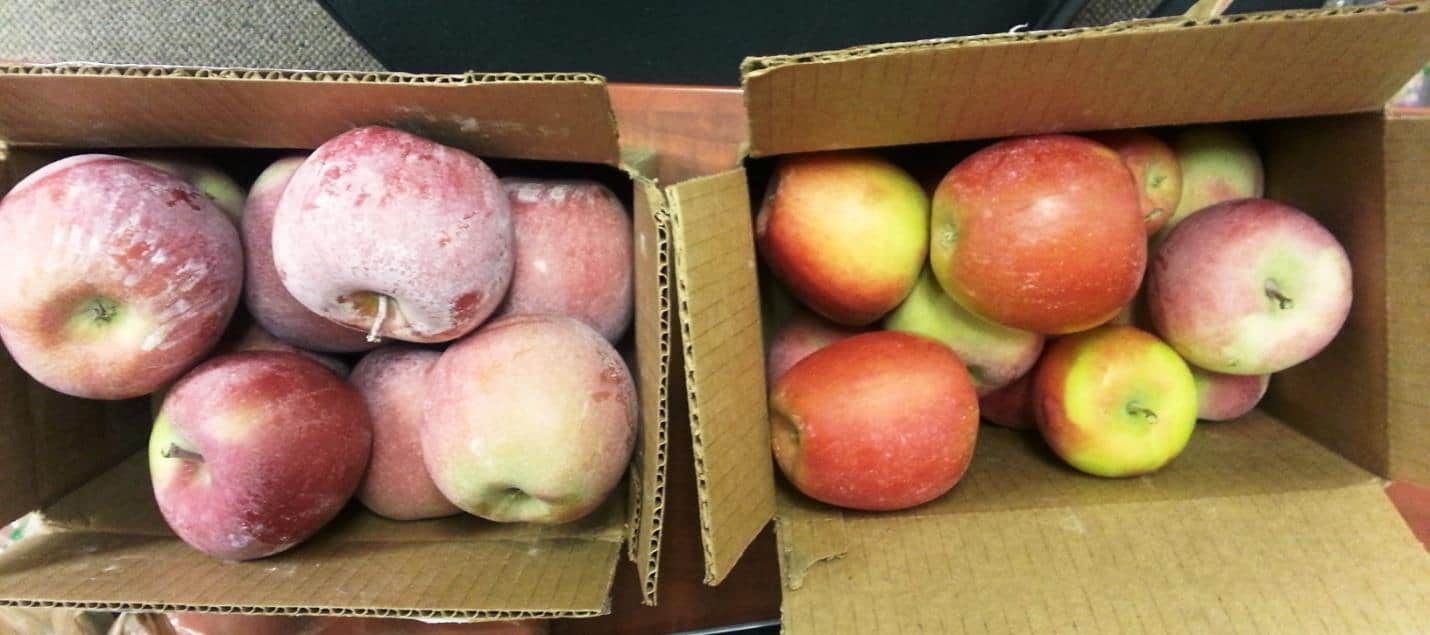
Washington orchard — scale on the fruitDeposits held top-grade share to ~50% despite acid dosing. With conditioned spray water: over 90% top grade, a clearer pond in 2 weeks, and no more filter-clogging snails.
- →
Italy Cycas nursery — 350 ppm well waterNozzles dismantled and chemically cleaned on rotation; valves dripping. One K40 on the 50 mm line: no further sprayer clogging, valve drips stopped, stable pressure across six acres.
- →
South America — greenhouse rosesBetter water delivery, measured on the crop: stems 18.5% longer, 89% reaching 50 cm, output up 72.8% through the cold season. Nine-month evaluation.
These are single-site trials, not peer-reviewed studies; each links to its full write-up including method and duration. For the underlying science, see the FAO’s Water Quality for Agriculture (Irrigation & Drainage Paper 29), NDSU Extension’s guidance on irrigation well maintenance, and the Water Well Journal’s maintenance guidelines.
Not just farms: who else runs on borehole water
Agriculture is the biggest user of private groundwater, but the same chemistry hits every site that pumps its own supply — and the treatment logic is identical: one unit where the water enters the system, everything downstream protected.
- →
Hotels, resorts and golf coursesPrivate wells feed kitchens, laundries, pools and turf irrigation — scale hits calorifiers and sprinkler heads alike.
- →
Food and beverage plantsBreweries, dairies and bottling lines on borehole supplies fight scale in pasteurisers, boilers and wash systems.
- →
Manufacturing and miningProcess and dust-suppression water drawn from wells scales spray nozzles, pumps and pipelines.
- →
Rural homes and smallholdingsPrivate wells scale immersion heaters, showers and appliances — a compact unit at the tank inlet covers the whole house.
- →
Holiday parks, pools and leisure sitesBorehole-fed pools and shower blocks carry the same hardness into heaters, filters and pumps.
Whatever the sector, the rule holds: if the water comes out of the ground on your land, treat it where it enters your system — not appliance by appliance.
The questions growers actually ask
How do I keep drip emitters from clogging?
Three defences, in order: filter out the particles (sand, silt, organics), manage the dissolved calcium that becomes scale as water exits the emitter, and control the biofilm that glues both together. Filtration alone can’t do it — dissolved minerals pass straight through. In the Saudi olive grove trial, conditioning the water cut well-restart flushing from 30 minutes to 2 and reduced clogging risk by up to 50%.
How do I unclog a drip emitter?
Flush the laterals at full pressure first. Mineral crust responds to an acid flush (follow the emitter manufacturer’s guidance); slime responds to chlorine injection. Emitters that keep re-clogging are usually cheaper to replace than rescue — then fix the water, or the cycle repeats next season.
Why do borehole pumps fail early?
Mineral incrustation and iron bacteria narrowing the screen, sand wearing the impellers, and pumping below screen level. Incrustation feeds itself: blocked slots speed up the remaining flow, which deposits minerals faster. NDSU Extension recommends rehabilitation once a well’s specific capacity drops to about 80% of new — and tracking flow and drawdown yearly so you notice.
How do you soften borehole water for irrigation?
Mostly, don’t. A salt softener swaps calcium for sodium, and sodium damages soil structure — the FAO’s SAR limits exist for exactly this reason. At irrigation volumes the salt cost is prohibitive anyway. Realistic options are acid dosing, blending with a second source, or physical conditioning that changes how calcium behaves without adding anything.
Is hard water bad for plants?
Not directly — calcium and magnesium are nutrients. The harm is indirect: clogged emitters watering unevenly, deposits grading down fruit, and high-TDS water suppressing germination. The Washington orchard saw top-grade share rise from ~50% to over 90% once spray-water scale stopped sticking.
Do I need a borehole water filter or a water conditioner?
Different problems, often both. Filters remove suspended particles; they cannot touch dissolved calcium, which becomes scale downstream. Conditioners address the dissolved minerals but don’t remove grit. Diagnose from the symptom: gritty deposits mean filtration; hard white crust means conditioning; slime means biological control. Many farms need a filter for particles with a conditioner protecting everything, filter included.
Size the unit for your line
Tell us your pipe diameter, water hardness or TDS if you know it, and what keeps clogging — the team in Nottingham will size the right borehole water treatment unit.
- →
HydroFLOW K40Nursery and smallholding lines — the unit from the Italy trial.
- →
Custom units10-inch-plus mainlines and well discharges — as used in the Saudi and roses trials.
- →
Agriculture overviewEvery farm application in one place.
- →
Talk to usPipe size and a water report is all we need to size the unit.